
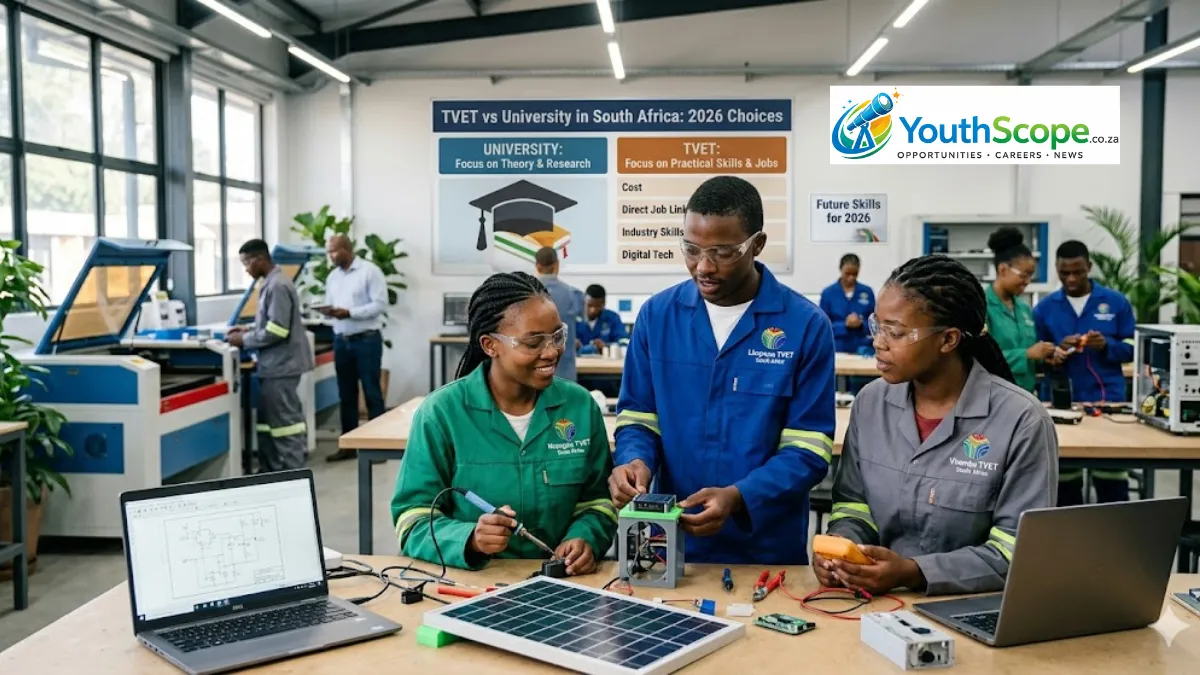
For decades, the South African “dream” for matriculants was singular: get a Bachelor’s pass, head to a top-tier university, and secure a degree. But as we move through 2026, the narrative has fundamentally shifted. The “Degree-or-Bust” era is being replaced by a pragmatic, skills-first movement that is seeing record interest in Technical and Vocational Education and Training (TVET) colleges.
Driven by a combination of extreme university placement competition, the rise of the “Green Economy,” and the immediate need for “work-ready” skills, young South Africans are no longer viewing TVETs as a “Plan B.” They are a strategic first choice.
The Numbers Game: Why Universities are Overflowing
The class of 2025 produced over 650,000 passes, yet the public university system remains structurally capped. In 2026, many major universities reported receiving applications at a rate 30 times higher than their available first-year seats.
This bottleneck has forced a national conversation about where the other 500,000+ students go. While 46.4% of candidates achieved a Bachelor’s pass, the reality is that thousands of these students are finding their way into TVET occupational programmes instead of traditional lecture halls.
TVET vs. University: The 2026 Comparison
The choice between these two paths now comes down to Learning Style and Speed to Income.
| Feature | University (Traditional) | TVET College (Vocational) |
| Learning Focus | Theoretical and Abstract | Practical and Hands-on |
| Duration | 3–4 Years Minimum | 18 Months Theory + 18 Months Practical |
| Industry Readiness | Often requires post-grad internships | Graduates with 18 months of work experience |
| Cost | High (R50k – R100k+ per year) | Lower (R10k – R30k per year) |
| NSFAS Support | Full funding available | Full funding + growing accommodation parity |
The “Red Seal” Advantage: Earning Potential in 2026
One of the biggest drivers for the TVET surge is the Artisan Shortage. In 2026, a “Red Seal” qualified artisan—such as a Diesel Mechanic, Solar Electrician, or Boiler Maker—often enters the workforce with higher earning potential than a general Humanities or Management university graduate.
Top In-Demand TVET Sectors:
- Renewable Energy: With South Africa’s aggressive pivot toward green energy, Solar Technicians are among the fastest-hired graduates.
- Coding & AI: Modern TVET campuses, like the uMasinga TVET Smart Campus, are now offering high-tech diplomas in Data Analytics and Cybersecurity.
- Infrastructure: Civil construction and welding remain the “economic nerve center” of the developing nation.
Breaking the Stigma: TVET is Not for “Failures”
Historically, TVET colleges suffered from a perception problem, often labeled as places for students who “couldn’t make it” into university. In 2026, government and industry leaders are actively dismantling this myth.
The introduction of QCTO-accredited occupational programmes has seen a 99% success rate in some sectors, far outperforming traditional academic routes. Furthermore, a new dual-enrolment model is being explored, allowing students to register for modules at both a college and a university simultaneously—bridging the gap between the two worlds.
The Role of Funding: NSFAS and SETAs
Funding remains the ultimate gatekeeper for South African students. While NSFAS continues to provide the bulk of support, SETAs (Sector Education and Training Authorities) have stepped up in 2026, providing over R2 billion in bursaries specifically for TVET and trade-related learning.
This diversification of funding means that a student choosing the vocational route often has more “Learn-while-you-Earn” opportunities through paid apprenticeships than their university counterparts.
You can also Check:
FAQ: Making the Choice in 2026
Is a TVET diploma worth as much as a University degree?
In terms of the National Qualifications Framework (NQF), a TVET National N-Diploma is generally at NQF Level 6, while a Bachelor’s degree is NQF Level 7. However, in practical trades, employers value the NQF 6 + Practical Experience more than a theoretical degree.
Can I go to University after attending a TVET college?
Yes. This is called Articulation. Many students complete a TVET diploma and then “articulate” into a university degree with credits, often finishing their degree in less time.
Which is better for starting my own business?
TVET colleges are specifically designed for entrepreneurship. Because you learn a physical skill (like plumbing, catering, or coding), you graduate with the ability to sell a service immediately, whereas university degrees often prepare you for corporate employment.
Are TVET applications still open for 2026?
While annual registrations for many public TVETs closed in late February, short skills programmes and occupational courses often have rolling intakes throughout the year.

Mbalizuke Nkosi is the editorial voice behind YouthScope.co.za, a South African youth-focused platform dedicated to providing reliable information on opportunities, education, and career development. The platform serves students, graduates, job seekers, and young professionals by delivering accurate, timely, and easy-to-understand content.
Through informative and professionally curated content, YouthScope.co.za aims to equip young people with the knowledge and resources needed to make informed decisions about their education and future careers.
For inquiries or support, please contact admin@youthscope.co.za.