
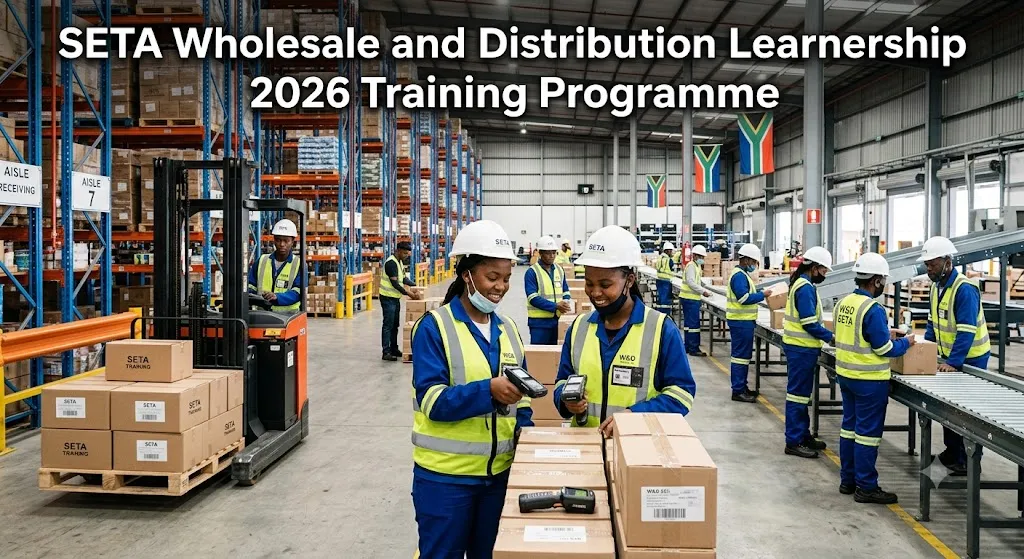
SETA careers in Wholesale and Distribution 2026 are funded through the Wholesale & Retail Sector Education and Training Authority (W&RSETA). These programmes are designed to help unemployed South African youth gain real workplace experience + accredited qualifications in the retail supply chain and distribution industry.
This sector includes:
- Warehousing and stock control
- Logistics and supply chain operations
- Wholesale trade companies
- Retail distribution centres
- Customer service and merchandising
The programme is usually offered as a 12-month learnership contract combining classroom learning and workplace training.
These learnerships are aligned with the National Qualifications Framework (NQF), meaning your qualification is recognised across South Africa.
What is a SETA Wholesale & Distribution Learnership?
A SETA wholesale and distribution learnership is a structured programme that:
✔ Combines theory + workplace training
✔ Leads to an NQF-accredited qualification
✔ Prepares you for entry-level jobs in logistics & retail supply chains
✔ Is funded by W&RSETA through employer partnerships
You do NOT apply directly to SETA — you apply through companies like:
- Retail chains
- Wholesale distributors
- Logistics companies
- Distribution centres
Eligibility Requirements
To qualify for most 2026 wholesale and distribution SETA learnerships, you typically need:
- South African citizenship
- Grade 10–12 (Matric preferred)
- Unemployed youth (18–35 years)
- Basic literacy and numeracy
- Good health condition
- No prior completion of same learnership
Some employers may also require:
- Communication skills
- Computer literacy
- Willingness to work shifts
Stipend / Salary Details
Most SETA wholesale and distribution learnerships offer:
- Monthly stipend: R3,000 – R6,000+
- Transport allowance (in some cases)
- Basic workplace support (varies by employer)
Example: Hardware and retail distribution learnerships in Limpopo offer around R3,500 monthly stipend for 12 months.
Important: Stipends differ depending on employer and province.
Required Documents Checklist
Prepare the following:
- Certified copy of South African ID
- Certified copy of Matric or Grade 10–12 certificate
- Updated CV
- Proof of residence
- Banking details (if shortlisted)
- Affidavit (if required for unemployment proof)
Step-by-Step Application Process
Step 1: Find an employer
Look for companies in wholesale, logistics, or retail distribution offering SETA learnerships.
Step 2: Prepare documents
Ensure all documents are certified (not older than 3 months).
Step 3: Apply online or manually
Submit your application through:
- Company careers page
- Recruitment portals
- Walk-in applications (rare cases)
Step 4: Shortlisting process
If selected, you may be invited for:
- Interview
- Basic skills test
Step 5: Sign learnership contract
Successful candidates sign a 12-month SETA learnership agreement
Step 6: Start training
You begin a combination of:
- Classroom learning
- Workplace training in logistics/distribution
Closing Date
Closing dates vary per company.
Typical intake periods:
- March – May (mid-year intake)
- September – November (year-end intake)
Example: Some 2026 retail SETA programmes close around May 16, 2026.
Related Opportunity
You may also explore
Youthscope
Frequently Asked Questions (FAQ)
Do I need experience?
No. These programmes are designed for beginners.
Do I get a certificate?
Yes, you receive an NQF-accredited qualification.
Can I apply without Matric?
Yes, some programmes accept Grade 10–11.
Is it guaranteed job placement?
No, but it improves your chances of employment significantly.
Do I apply through SETA directly?
No, you apply through employers.
Career Pathways After Completion
After completing a wholesale and distribution learnership, you can work as:
- Warehouse assistant
- Stock controller
- Logistics clerk
- Distribution assistant
- Retail operations assistant
- Supply chain junior staff
With experience, you can progress to:
- Warehouse supervisor
- Logistics coordinator
- Supply chain manager
Related Opportunity
TETA Programmes 2026: Learnerships, Internships, Qualifications and Career Opportunities Explained
Expert Guidance (E-E-A-T)
By Mbalizuke Nkosi – Education & Skills Development Analyst (South Africa)
Wholesale and distribution learnerships remain one of the strongest entry points for unemployed youth because they combine practical workplace exposure with nationally recognised qualifications. However, success depends on consistency — many learners fail to complete programmes due to absenteeism or lack of discipline.
Applicants should focus on:
- Applying early in recruitment cycles
- Keeping documents ready at all times
- Targeting multiple employers, not just one
- Treating the learnership like a full-time job from day one
These programmes are not just “training opportunities” — they are structured pipelines into South Africa’s logistics and retail economy.
⚠️ Disclaimer
This article is for informational purposes only. SETA learnership availability, stipends, and requirements vary by employer and province. Always confirm details through official company websites or accredited training providers before applying. We are not affiliated with W&RSETA or any employer mentioned.

Mbalizuke Nkosi is the editorial voice behind YouthScope.co.za, a South African youth-focused platform dedicated to providing reliable information on opportunities, education, and career development. The platform serves students, graduates, job seekers, and young professionals by delivering accurate, timely, and easy-to-understand content.
Through informative and professionally curated content, YouthScope.co.za aims to equip young people with the knowledge and resources needed to make informed decisions about their education and future careers.
For inquiries or support, please contact admin@youthscope.co.za.