
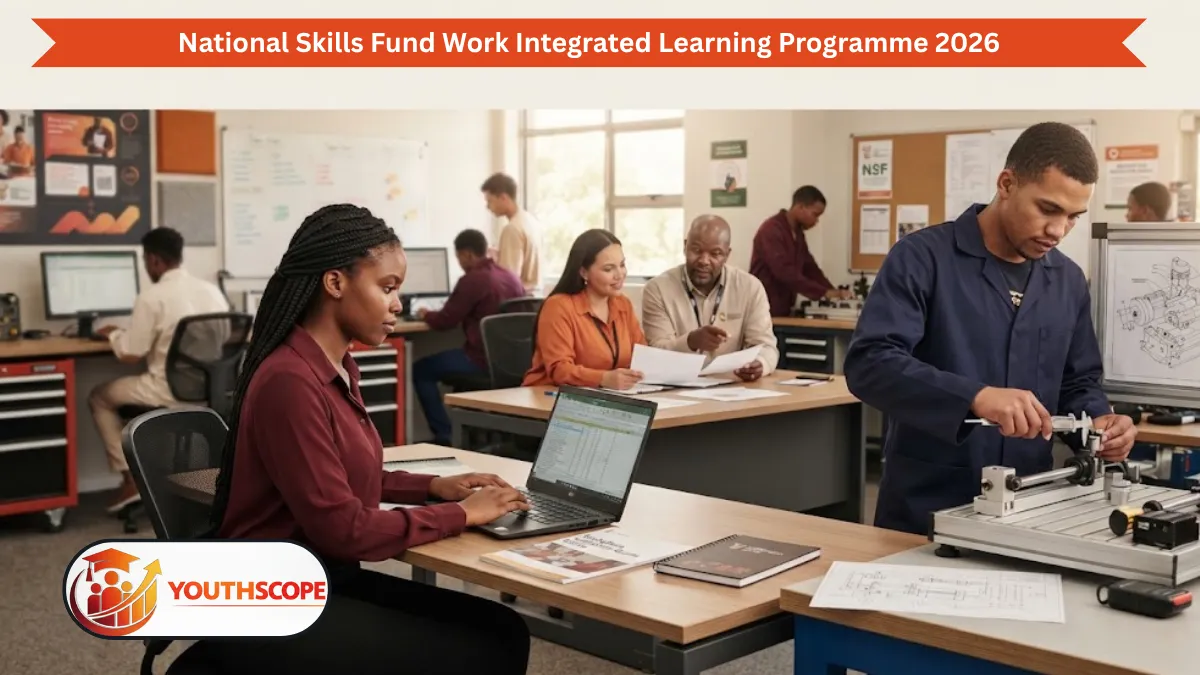
National Skills Fund Work Integrated Learning Programme 2026: Requirements and How to Apply
Students and graduates who need practical workplace experience can benefit from the National Skills Fund (NSF) Work Integrated Learning (WIL) Programme. The programme supports workplace-based learning for students completing qualifications, graduates requiring practical experience and other learners whose studies require workplace exposure.
The NSF explains that WIL is intended to help bridge the gap between tertiary education and the labour market by giving participants opportunities to apply their knowledge in real workplace environments.
Quick Overview
| Information | Details |
|---|---|
| Organisation | National Skills Fund (NSF) |
| Opportunity | Work Integrated Learning (WIL) Programme |
| Location | South Africa |
| Qualification | Depends on the specific WIL opportunity |
| Age | Not specified as a universal NSF WIL requirement |
| Target group | Students and graduates requiring workplace learning |
| Duration | 18, 24 or up to 36 months, depending on category |
| Stipend | Varies by individual funded project; no universal amount confirmed |
| Closing date | No single closing date for the overall WIL programme |
| Application method | Follow the application process in the relevant NSF or implementing-partner advertisement |
What Is the National Skills Fund WIL Programme?
Work Integrated Learning allows students and graduates to gain experience in a workplace while applying knowledge obtained through their studies.
According to the NSF, its WIL programme has several purposes, including providing workplace learning required to complete academic qualifications, supporting graduates who need practical experience for professional development and helping graduates gain experience that may improve their future employment prospects.
The programme is therefore particularly relevant to young people who have completed much of their theoretical training but still need practical workplace exposure.
Who Can Apply?
The NSF identifies several categories of potential WIL beneficiaries.
Unemployed Graduates
Unemployed graduates from TVET colleges, universities of technology and universities can be considered for workplace-learning opportunities.
The NSF’s WIL framework identifies a period of 24 months for unemployed graduates from these institutions, depending on the relevant programme.
TVET Students With N6
TVET students who have completed N6 studies in business or engineering fields may require workplace experience to obtain their National N Diploma.
The NSF identifies periods of 18 or 24 months, depending on the qualification.
Students Requiring In-Service Training
Students whose qualifications require practical workplace exposure or in-service training may also fall within the WIL programme.
The exact requirements depend on the qualification and the institution’s workplace-learning requirements.
Students in Professional Studies
Some professional qualifications require practical workplace experience before the qualification can be completed.
The NSF indicates that certain professional-study placements can extend for up to 36 months, depending on the programme.
Why This Opportunity Matters
A qualification can provide theoretical knowledge, but workplace experience allows learners to understand how that knowledge is applied in practice.
WIL can help participants:
- Gain practical workplace experience
- Apply academic knowledge to real tasks
- Develop technical skills
- Improve communication and teamwork
- Build workplace confidence
- Develop professional networks
- Strengthen their CVs
- Understand workplace procedures
- Improve their readiness for employment
The NSF specifically describes WIL as a mechanism for helping young people transition from tertiary education into the labour market.
Who Should Not Apply?
The NSF WIL programme is not a single vacancy with one set of requirements.
You should not apply to a particular WIL opportunity if you do not meet the requirements stated in that specific advertisement.
For example, an opportunity requiring an N6 qualification and workplace experience to complete a National Diploma may not be appropriate for someone who does not have the required academic background.
Always check the individual advertisement before submitting an application.
Requirements
There is no single set of requirements covering every NSF-funded WIL placement.
Depending on the programme, applicants may need to:
- Be enrolled at an eligible institution and require workplace learning; or
- Have completed a relevant qualification and require workplace experience
- Hold the qualification specified in the advertisement
- Meet the requirements of the implementing organisation
- Provide proof of academic qualifications or student status
- Meet any additional requirements specified for the placement
The NSF confirms that its WIL programme covers different beneficiary categories, so requirements can differ according to the qualification and type of workplace learning required.
Stipend / Salary
No single NSF WIL stipend amount should be assumed for every opportunity.
The NSF’s official WIL information describes the programme and its beneficiary categories but does not publish one universal stipend applicable to all WIL placements. Individual funded projects can have their own stipend arrangements.
This distinction is important because an amount advertised for one NSF-funded project should not automatically be presented as the stipend for every NSF WIL opportunity.
The NSF has also confirmed that it funds WIL through projects and implementing partners, and that stipend administration can be handled by the appointed provider. In a 2026 statement concerning one WIL project, the NSF clarified that the implementing Skills Development Provider was responsible for stipend payments to learners.
Duration
The duration depends on the type of workplace learning required.
The NSF identifies:
- 24 months for unemployed graduates from TVET colleges, universities of technology and universities.
- 18 or 24 months for certain N6 TVET students requiring workplace learning for their National Diplomas.
- Up to 36 months for some professional studies requiring workplace experience.
Therefore, applicants should not assume that every NSF WIL opportunity lasts exactly 24 months.
Documents Required
The exact documents depend on the individual advertisement, but applicants should be prepared to provide documents such as:
- Updated CV
- Certified qualification certificates, where requested
- Academic record, where requested
- Proof of student status, where applicable
- Proof of identity
- Proof of workplace-learning requirements, where applicable
- Any additional documents specified by the implementing organisation
Only submit documents requested by the official application notice.
How to Apply
There is no single application form or permanent application deadline for every NSF-funded WIL placement.
Step 1: Check the official NSF information
Visit the NSF’s official Work Integrated Learning information page to understand the programme and beneficiary categories.
Step 2: Look for a specific WIL intake
NSF-funded workplace-learning opportunities can be implemented through different organisations and institutions. Look for an official advertisement that matches your qualification and workplace-learning requirements.
Step 3: Check the eligibility requirements
Read the complete advertisement before applying. Pay particular attention to the qualification, student or graduate status, location, duration and any other requirements.
Step 4: Prepare your documents
Prepare your CV and the supporting documents requested in the advertisement.
Step 5: Apply through the stated channel
Use only the application method specified in the official advertisement.
Do not assume that an NSF WIL programme can be applied for through an unofficial third-party form.
Important Before You Apply
The NSF WIL programme should not be confused with one continuously open internship vacancy.
The NSF’s official website explains that its WIL programme supports different categories of workplace learning.
The NSF Careers page also states that its own graduate internship programme is open to TVET students with an N6 Certificate requiring WIL and post-school graduates from universities and TVET colleges, with that internship lasting 24 months. The page says the programme is recruited in cohorts.
This means applicants should distinguish between:
NSF’s broader WIL programme
and
a specific NSF-funded WIL project or NSF graduate internship intake.
They can have different application procedures, requirements, dates and stipend arrangements.
Beware of scams
Never pay someone who promises to secure an NSF placement for you.
Verify the opportunity through the NSF, the relevant educational institution or the officially identified implementing organisation before submitting personal documents.
Official Source
National Skills Fund – Work Integrated Learning
Official NSF Work Integrated Learning page
The NSF’s official page confirms the programme’s purpose, beneficiary categories and indicative workplace-learning periods.
NSF Careers
The Careers page provides information about NSF’s graduate internship and WIL programme.
Frequently Asked Questions
1. What is the NSF WIL Programme?
It is a National Skills Fund workplace-learning programme designed to provide students and graduates with practical workplace experience and support the transition from tertiary education to employment.
2. Who can benefit from NSF WIL?
The NSF identifies unemployed graduates, N6 TVET students requiring workplace learning, students requiring in-service training and students undertaking professional studies requiring practical workplace experience.
3. How long is NSF WIL?
The duration varies. The NSF identifies 18-month, 24-month and, for some professional studies, up to 36-month periods.
4. Does NSF WIL have a fixed stipend?
No universal stipend should be assumed. Stipend arrangements can differ between individual funded projects.
5. Is NSF WIL only for unemployed graduates?
No. The NSF also identifies students who require workplace learning as part of their qualifications, including certain N6 TVET students.
6. Is NSF WIL the same as an internship?
Not necessarily. WIL is a broader workplace-learning category that can support students and graduates who require practical experience as part of their academic or professional pathway.
7. Is there one closing date for NSF WIL?
No single closing date applies to the entire WIL programme. Specific funded opportunities or intakes can have their own deadlines.
8. Where can I verify NSF WIL information?
Use the official NSF website and the specific advertisement issued by the relevant implementing organisation or institution.
Related Opportunities
Youthscope readers can also explore related categories such as:
- TVET internships
- Graduate programmes
- Government internships
- Learnerships
- Apprenticeships
- Workplace-based learning opportunities
- Entry-level jobs for graduates
Youthscope Verification
Source: National Skills Fund official website
Programme: Work Integrated Learning
Last checked: 2 September 2026
Status: Programme information verified against the official NSF website.
The NSF’s official WIL page currently confirms the programme’s purpose and beneficiary categories.
Important: This article describes the NSF WIL programme framework. It is not a claim that a specific WIL vacancy is currently accepting applications. Applicants should verify the availability, deadline, requirements and application method of each individual intake.
Editorial Information
Author: Mbalizuke Nkosi
Reviewer: Youthscope Editorial Team
Published: 2 September 2026
Updated: 2 September 2026

Mbalizuke Nkosi is the editorial voice behind YouthScope.co.za, a South African youth-focused platform dedicated to providing reliable information on opportunities, education, and career development. The platform serves students, graduates, job seekers, and young professionals by delivering accurate, timely, and easy-to-understand content.
Through informative and professionally curated content, YouthScope.co.za aims to equip young people with the knowledge and resources needed to make informed decisions about their education and future careers.
For inquiries or support, please contact admin@youthscope.co.za.