Category Archives: Students News

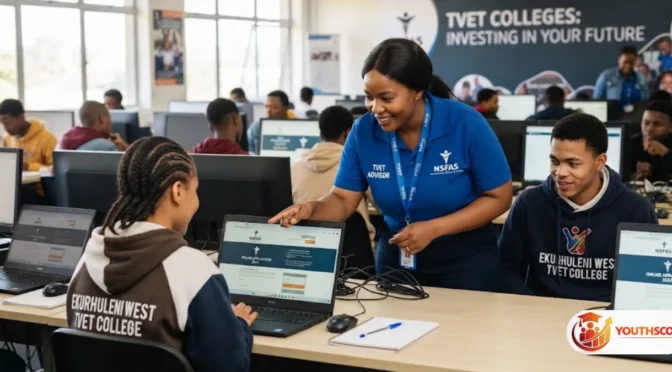
NSFAS 2026 TVET Semester 2 Applications Now Open – Students Have Until 17 July to Apply for Funding

NSFAS 2026 TVET Semester 2 Applications Now Open

Students planning to study at a South African TVET College during Semester 2 of the 2026 academic year can now apply for NSFAS funding.

Applications officially opened on 1 July 2026 and will close on 17 July 2026. Eligible students are encouraged to apply as early as possible to avoid missing the deadline and to ensure their applications are submitted correctly.

The funding application is completed online, and applicants must choose the correct application process cycle before submitting.

Opportunity Overview

The National Student Financial Aid Scheme (NSFAS) provides financial assistance to qualifying South African students enrolled at public TVET Colleges.

The Semester 2 application window is specifically intended for students beginning their studies during the second semester of the 2026 academic year, including qualifying Occupational Qualification (OQ) second intake students.

Submitting an accurate application before the deadline is essential, as applications submitted under the wrong process cycle may not be considered.

NSFAS 2026 TVET Semester 2 Application Dates

  • Applications Open: 1 July 2026
  • Applications Close: 17 July 2026

No late applications may be accepted after the closing date.

Who Should Apply?

This application window is for:

  • Students enrolling for TVET College Semester 2 in 2026.
  • Occupational Qualification (OQ) second intake students.
  • Eligible South African citizens who meet NSFAS funding requirements.
  • Students studying at public TVET Colleges.

Correct Process Cycle to Select

Applicants must select the correct process cycle before submitting their application.

  • Semester 2 students: Select Semester 2
  • Occupational Qualification second intake students: Select OQ2

Choosing the wrong process cycle may result in your application not being considered.

Eligibility Requirements

Applicants should:

  • Be a South African citizen or meet NSFAS eligibility criteria.
  • Be registered or intending to register at a public TVET College.
  • Meet the NSFAS household income requirements.
  • Submit a complete online application before the closing date.

Stipend and Funding Details

Successful applicants may receive NSFAS funding that covers approved study costs, which can include:

  • Tuition fees
  • Registration fees (where applicable)
  • Learning materials
  • Accommodation (where eligible)
  • Transport allowance (where applicable)
  • Personal care allowance (where applicable)

Funding is subject to the official NSFAS rules and eligibility criteria.

Required Documents Checklist

Prepare the following before applying:

  • South African ID or valid identification document
  • Personal contact details
  • Proof of income (if required)
  • Supporting documents requested by NSFAS
  • Any additional documents requested during the online application

How to Apply for NSFAS 2026 TVET Semester 2 Funding

Step 1

Visit the official NSFAS online application portal.

Step 2

Log in or create a myNSFAS account.

Step 3

Complete your personal information.

Step 4

Select the correct application process cycle:

  • Semester 2
  • OQ2 (where applicable)

Step 5

Upload all required supporting documents.

Step 6

Review every section carefully.

Step 7

Submit your application before 17 July 2026.

Why You Should Apply Early

Applying early gives you enough time to:

  • Check that all your personal details are correct.
  • Upload the correct supporting documents.
  • Correct any mistakes before the deadline.
  • Avoid delays caused by heavy website traffic.
  • Ensure you selected the correct process cycle.

Closing Date

Closing Date: 17 July 2026

Late applications may not be accepted.

Related Opportunity

Youthscope

Frequently Asked Questions (FAQ)

When do NSFAS TVET Semester 2 applications close?

Applications close on 17 July 2026.

Who should apply?

Students registering for Semester 2 or Occupational Qualification second intake at public TVET Colleges.

Can I apply after the deadline?

No. Applications submitted after the closing date may not be considered.

What happens if I choose the wrong process cycle?

Applications submitted under the incorrect process cycle may not be processed.

Where do I apply?

Applications are submitted online through the official NSFAS website.

Career Pathways After Completing a TVET Qualification

Completing a TVET qualification can open opportunities in various industries, including:

  • Engineering
  • Business Management
  • Information Technology
  • Hospitality
  • Agriculture
  • Finance
  • Construction
  • Electrical Engineering
  • Public Sector Employment
  • Entrepreneurship

Expert Guidance (E-E-A-T – Mbalizuke Nkosi)

Expert Guidance by Mbalizuke Nkosi

If you qualify for NSFAS funding, submit your application as early as possible rather than waiting until the final days. Early applications reduce the risk of technical issues and give you time to correct any mistakes. Before submitting, carefully confirm that you have selected the correct application process cycle, uploaded all required documents, and reviewed every section of your application. Paying attention to these details can help prevent unnecessary delays during the funding assessment process.

Why You Should Apply for This Opportunity

NSFAS funding helps thousands of South African students continue their education without the financial burden of tuition and other approved study costs.

Applying on time could provide access to financial support that enables you to complete your qualification, improve your skills, and increase your future employment opportunities.

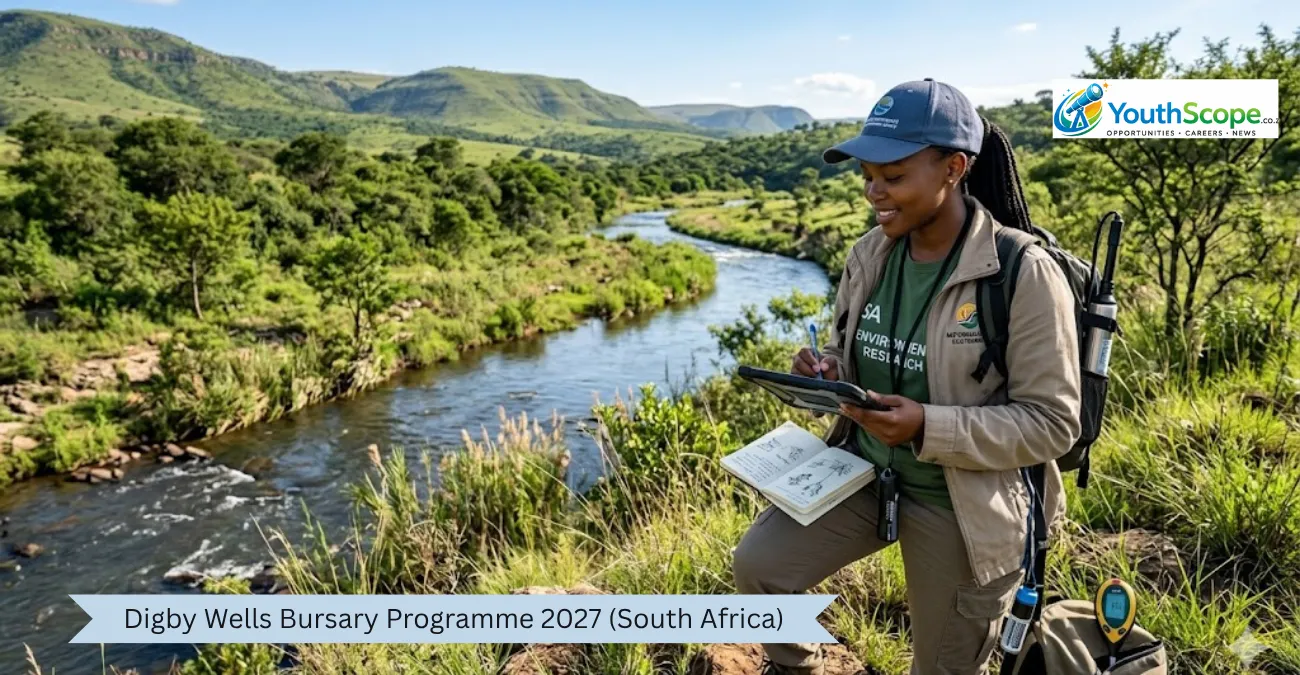
Digby Wells Bursary Programme 2027 (South Africa)

If you are a South African student passionate about environmental sustainability, the Digby Wells Bursary Programme 2027 offers financial support and career development in high-demand environmental fields.

This bursary is designed to support hardworking, high-performing students who want to build a career that contributes to sustainable development in South Africa.

What You Need (Checklist)

Before applying, make sure you have:

  • Certified copy of your South African ID
  • Matric results or certificate
  • Academic transcripts (if currently studying)
  • Proof of university acceptance or registration
  • Updated CV with contact details
  • Motivational letter aligned with environmental goals

Bursary Overview

  • Programme: Digby Wells Bursary Programme 2027
  • Company: Digby Wells Environmental
  • Closing Date: Not specified (Apply as soon as possible)
  • Location: South Africa
  • Target Group: Students pursuing environmental-related qualifications

Why This Bursary Matters

Environmental careers are becoming increasingly important in South Africa due to:

  • Climate change challenges
  • Growing demand for sustainable development
  • Increased focus on environmental compliance

This bursary supports students entering fields that are critical to the country’s future while also offering career pathways after graduation.

Fields of Study Covered

The bursary supports studies in:

  • Aquatic Ecology
  • Community Development
  • Environmental Management
  • Environmental Science
  • Geographical Information Systems (GIS)
  • Hydrogeology
  • Hydrology
  • Social Sciences
  • Sociology
  • Stakeholder Engagement

What the Bursary Covers

Successful applicants will receive:

  • Full or partial tuition fees
  • Book allowance
  • Laptop

Additional Benefits

  • Opportunity for vacation work or internships
  • Potential employment with Digby Wells Environmental after graduation
    (linked to the bursary funding period)

Who Should Apply

This opportunity is ideal for students who are academically strong and purpose-driven.

Minimum Requirements

  • Must be a South African citizen
  • Must be in Matric or have completed Matric
  • Must study or plan to study full-time
  • Must be accepted at a recognised tertiary institution
  • Must have a strong academic record
  • Must show a clear interest in environmental sustainability
  • Must demonstrate responsibility and commitment to society

Required Supporting Documents

Prepare the following documents carefully:

  • Certified copy of ID
  • Matric certificate or results
  • Academic transcripts
  • Proof of university acceptance/registration
  • Updated CV
  • Motivational letter

Your motivational letter is especially important—it shows your purpose and alignment with the organisation.

How to Apply

To apply:

  1. Prepare all required documents
  2. Ensure documents are clear and certified
  3. Submit your application via the official Digby Wells application platform

Click here to apply for Digby Wells Bursary South Africa 2027:

Important: The closing date is not specified, so apply as early as possible to avoid missing out.

Why Applications Get Rejected

Many strong students are rejected due to:

  • Weak or generic motivational letters
  • Missing supporting documents
  • Poorly presented applications
  • Lack of clear career direction

Expert Insight: How to Strengthen Your Application

A common mistake is writing a generic motivational letter that does not connect your goals to the environmental sector.

Many applicants say they “want to help the environment” but do not explain how.

Pro Tip

Write a focused motivation:

  • Explain why you chose your specific field (e.g., hydrology, GIS)
  • Link your goals to real environmental challenges in South Africa
  • Show how you plan to contribute to sustainability

This makes your application more credible and competitive.

Smart Application Strategy

To improve your chances:

  • Apply as early as possible
  • Ensure all documents are complete and certified
  • Tailor your CV and motivation
  • Apply to multiple bursaries as backup

You Can Also Explore Youthscope

If you are interested in similar opportunities, you can also check:

Frequently Asked Questions

Who can apply?

South African students in Matric or tertiary studies in environmental fields.

Does the bursary cover all costs?

It covers tuition, books, and a laptop, depending on funding.

Is work experience included?

Yes, there are opportunities for vacation work or internships.

Is there a job after graduation?

There may be employment opportunities, depending on performance and funding agreements.

NSFAS Placed Under Administration (2026): What South African Students Need to Know

What You Need to Know (Quick Checklist)

  • Your NSFAS funding is NOT cancelled
  • Allowances may be delayed during system changes
  • Direct payment systems are being introduced
  • Stricter verification checks are coming
  • Appeals and applications are still active
  • Always follow official NSFAS updates

What Happened at NSFAS in May 2026?

On 4 May 2026, the South African government placed the National Student Financial Aid Scheme (NSFAS) under administration. This decision followed weeks of instability within the organisation.

Key issues included:

  • A leadership crisis at board level
  • Disputes over the CEO appointment
  • Multiple board resignations
  • Concerns about financial controls and governance failures

The situation escalated to the point where the Minister of Higher Education intervened to stabilise the organisation.

What Does “Administration” Mean?

When an institution like NSFAS is placed under administration:

  • The board and executives lose control
  • An appointed administrator takes over
  • The focus shifts to fixing governance, finances, and operations

Important: This is not a shutdown. NSFAS is still operating—just under strict supervision.

Why Was NSFAS Put Under Administration?

1. Governance Breakdown

There was clear internal conflict:

  • Leadership disagreements
  • Poor decision-making structures
  • Interference in executive roles

This made it difficult for NSFAS to function effectively.

2. Financial Mismanagement Concerns

Investigations revealed serious issues:

  • Misallocation of funds (including billions flagged)
  • Weak oversight systems
  • Abuse within student accommodation payments

A new system is now being introduced to ensure direct payments to students and verified providers.

3. System Failures Affecting Students

Many students experienced:

  • Late allowance payments
  • Accommodation disputes
  • Delays in funding confirmation

These failures triggered urgent government intervention.

What This Means for Students in 2026

Your Funding Is Still Safe

  • Approved students remain funded
  • NSFAS continues to operate
  • Administration is about fixing the system—not removing funding

Payment Systems Are Changing

The new approach includes:

  • Direct payments to students
  • Improved tracking of allowances
  • Stronger verification processes

Expect short-term delays while systems are being updated.

Accommodation Issues Are Being Fixed

The new system aims to:

  • Pay only verified accommodation providers
  • Eliminate ghost listings
  • Prevent overcharging

This is designed to better protect students.

Stricter Checks from Institutions

Universities and TVET colleges will now:

  • Verify student data more strictly
  • Follow tighter financial rules

This may result in:

  • More document checks
  • Extra verification steps during registration

Appeals and Applications Continue

Students can still:

  • Appeal rejected applications
  • Track their funding status
  • Receive official updates

Why This Could Benefit Students

Although this situation sounds serious, there is a positive outcome.

Administration is used to:

  • Fix broken systems
  • Reduce corruption
  • Restore accountability

For students, this could mean:

  • More reliable payments
  • Less fraud
  • A more transparent NSFAS system

What Students Should Do Right Now

Stay Informed

  • Follow official NSFAS channels
  • Avoid misinformation on social media

Keep Your Documents Updated

Make sure your:

  • Banking details
  • Registration proof
  • Personal information

are accurate and up to date.

Be Patient but Proactive

  • Expect temporary delays
  • Report issues early
  • Track your payments regularly

Expert Insight: Common Mistake Students Make

A major mistake students make during system changes is ignoring requests for verification or updates.

Many assume delays will resolve automatically—but missing a document request can delay your funding even further.

Pro Tip

Check your NSFAS portal and email weekly. Respond quickly to any requests for documents or verification. Students who act fast are far less likely to experience long delays.

You Can Also Explore Youthscope

If you are interested in similar opportunities, you can also check:

Frequently Asked Questions (FAQ)

Is NSFAS shutting down?

No. NSFAS is still operating under administration.

Will I still receive my allowance?

Yes, but timelines may shift slightly during system changes.

Are new applicants still funded?

Yes. Applications and funding processes are continuing.

What is the biggest change?

The move to direct payment systems and stricter controls.

Should I be worried?

No panic is needed—just stay informed and prepared.

Final Thoughts

The decision to place NSFAS under administration is a serious but necessary step.

It highlights deep challenges—but also signals a system reset.

Key takeaway:
Your funding remains, but the system around it is being rebuilt.

If managed properly, this could lead to a more reliable and transparent NSFAS for South African students in the future.

CETA Funding Opportunities 2026/2027: Full Guide for South Africans

What You Need to Apply

  • South African ID
  • Registered company, training provider, or institution (for grants)
  • Or be an unemployed youth/student (for bursaries & learnerships)
  • Relevant qualifications or school results
  • Clear project or study plan (for funding proposals)
  • Access to the CETA online application system

What Are CETA Funding Opportunities?

The Construction Education and Training Authority (CETA) provides funding to support skills development in South Africa’s construction sector.

These opportunities are designed to:

  • Reduce unemployment
  • Build technical skills
  • Support infrastructure development

CETA mainly funds programmes through grants, bursaries, and workplace training initiatives.

Main CETA Funding Opportunities for 2026/2027

1. Discretionary Grants (DG Funding Window)

This is the biggest funding opportunity for 2026/27.

  • Open to employers, training providers, and organisations
  • Funds skills programmes and training projects
  • Focus on youth, women, and rural development

Key update: The 2026/27 Discretionary Grant window opened in January 2026 and closed around 16 February 2026.

2. Learnership Funding

CETA funds learnerships for:

  • Unemployed youth (±2,500 opportunities planned)
  • Construction-related qualifications

These programmes combine:

  • Classroom learning
  • Practical workplace experience

3. Apprenticeships

  • Around 1,000 apprenticeship opportunities targeted
  • Focus on trades like:
    • Plumbing
    • Electrical work
    • Bricklaying

4. Bursaries (University Funding)

Example: Thapelo Madibeng Bursary Scheme

Covers:

  • Tuition fees
  • Accommodation
  • Study materials
  • Living allowance

Supports careers like:

  • Civil engineering
  • Architecture
  • Construction management

5. Internships

  • Around 393 internship opportunities planned
  • Helps graduates gain real workplace experience

6. TVET & University Student Placements

  • TVET placements: ±355 opportunities
  • University placements: ±338 opportunities

These help students complete practical training requirements.

7. Short Skills Programmes

  • For both employed and unemployed learners
  • Focus on quick, practical skills training
  • Over 700+ opportunities combined

8. Recognition of Prior Learning (RPL)

  • Around 1,680 opportunities
  • Helps workers get formal recognition for existing skills

9. Mandatory Grants (For Employers)

  • Employers can claim back part of Skills Development Levy
  • Must submit:
    • Workplace Skills Plan (WSP)
    • Annual Training Report (ATR)

Deadline: Typically 1 Feb – 30 April annually

How to Apply for CETA 2026/2027 Funding

Step 1: Choose the Right Programme

  • Youth → Learnerships, internships, bursaries
  • Businesses → Grants and training funding

Step 2: Prepare Documents

  • Certified copies (ID, qualifications)
  • CV or company registration documents
  • Training or study plan

Step 3: Apply Online

Applications are submitted via the CETA Indicium system or through:

  • Employers
  • Training providers

Step 4: Apply Before Deadlines

Late applications are not accepted, especially for grants.

Expert Insight: Why Many People Miss CETA Funding

A common mistake is waiting for public adverts too late, especially for Discretionary Grants.

Why this matters:
Most funding windows are open for a short period (often 4–6 weeks only).

Pro Tip

Start preparing before the window opens:

  • Keep documents ready
  • Track announcements regularly
  • Partner with training providers early

This gives you a huge advantage over last-minute applicants.

You Can Also Explore Youthscope

If you are interested in similar opportunities, you can also check:

Final Thoughts

The CETA 2026/2027 funding opportunities offer multiple pathways—whether you’re a student, job seeker, or organisation.

From learnerships and bursaries to large-scale grants, these programmes are designed to help South Africans build real, in-demand construction skills.

If you act early and apply strategically, you can turn these opportunities into a long-term career or business advantage.

NSFAS Applications 2027: Expected Opening Date and What South African Students Should Know

Thousands of learners and students across South Africa are already asking when NSFAS applications for 2027 will open. Planning ahead is one of the smartest ways to improve your chances of a smooth funding process.

While the official date has not yet been confirmed, previous application cycles give a strong indication of when students can expect applications to begin.

What You Need to Prepare Now

  • South African ID or birth certificate
  • Parent/guardian proof of income
  • Signed consent form
  • Latest academic results (if required)
  • Working cellphone number
  • Active email address
  • Reliable internet access for online application

Expected NSFAS 2027 Opening Date

Based on previous NSFAS application periods, 2027 applications are expected to open in September 2026.

Likely Timeline

  • Opening Date: Mid to late September 2026
  • Closing Date: Around January 2027
  • Final dates will be announced by NSFAS officially.

In recent years, NSFAS has usually opened applications between September and October, allowing enough time before the academic year starts.

Why You Should Apply Early

Applying early can save you time, stress, and technical issues later.

Benefits of Applying Early

  • Avoid last-minute website delays
  • Fix missing documents in time
  • Reduce deadline pressure
  • Track your application sooner
  • Prepare for registration earlier

Waiting until the final weeks often leads to rushed mistakes and incomplete submissions.

Who Should Apply for NSFAS 2027?

You should apply if you are:

  • A South African citizen
  • Planning to study at a public university or TVET college in 2027
  • From a household earning R350,000 or less per year
  • A current Grade 12 learner in 2026
  • A returning student needing continued funding

Students Living With Disabilities

Applicants with disabilities may qualify under a higher household income threshold, depending on NSFAS rules.

NSFAS 2027 Application Requirements

To complete your application successfully, prepare these documents:

Required Documents

  • Certified copy of your ID or birth certificate
  • Parent/guardian proof of income
  • Signed consent form
  • Academic records if requested
  • Valid cellphone number and email

Important Tip

Ensure all uploaded documents are:

  • Clear and readable
  • Correctly certified (where required)
  • Saved in accepted file formats

How to Apply for NSFAS 2027

Applications are completed online through the official NSFAS portal.

Application Steps

  1. Create a myNSFAS account
  2. Log in and complete your profile
  3. Upload supporting documents
  4. Submit your application
  5. Track progress online

Always keep your login details private and safe.

Expert Insight: Common Mistake That Delays Applications

One of the biggest reasons students face delays is uploading the wrong documents or blurry copies.

Many applicants rush the process and only realise problems after closing dates.

Pro Tip to Stand Out

Before submitting:

  • Rename files clearly (ID, Income Proof, Results)
  • Check every page is readable
  • Use the same details across all forms
  • Submit in the first month after opening

Being organised helps your application move faster.

You Can Also Explore

If you are interested in similar opportunities, you can also check:

Smart Tips for South African Students

If You Are in Grade 12

Start gathering family documents now. Do not wait for final results.

If You Are a Returning Student

Check whether you need to reapply or update details based on your institution and funding status.

If You Plan to Study at TVET College

NSFAS also funds approved TVET programmes, so apply early.

Final Thoughts

Although the official NSFAS 2027 dates have not yet been released, students can reasonably expect applications to open around September 2026.

The best move right now is to prepare documents, understand requirements, and be ready to apply as soon as the portal opens.

Early preparation often makes the difference between a smooth application and a stressful one.

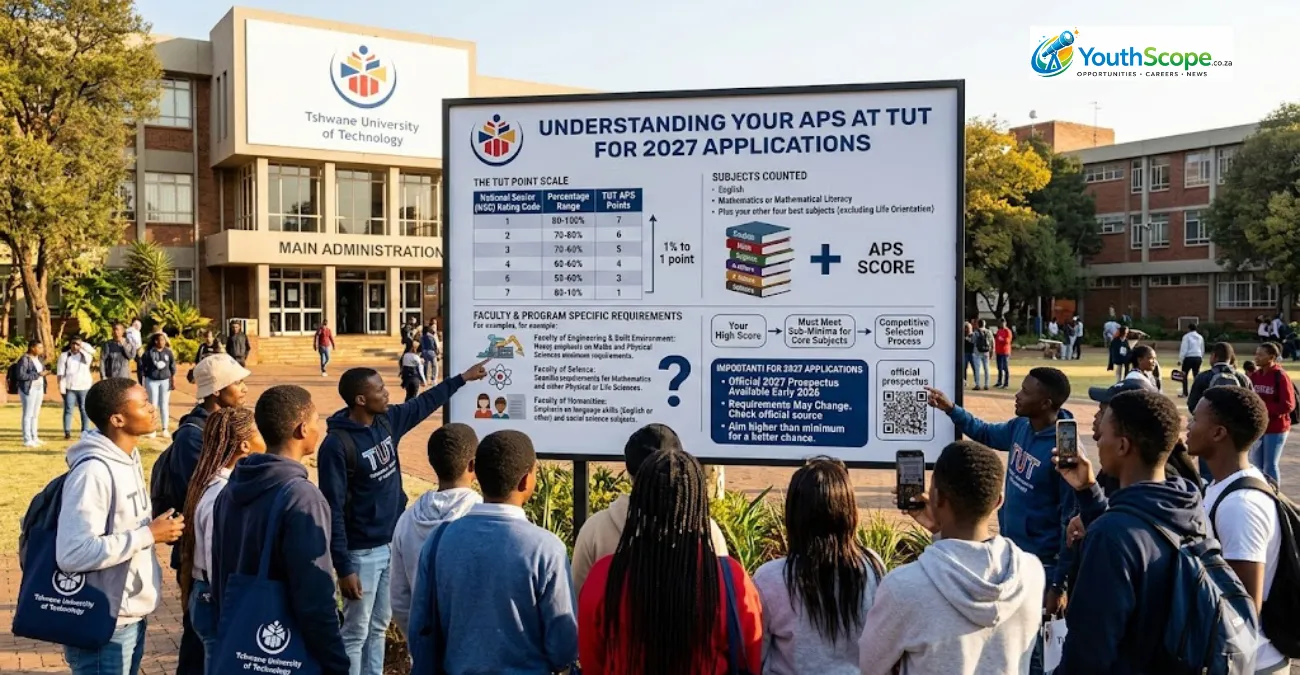
TUT APS Calculator 2027: How to Calculate Your Admission Point Score for Tshwane University of Technology

If you’re planning to study at the Tshwane University of Technology (TUT) in 2027, understanding your Admission Point Score (APS) is one of the most important steps in your application process.

Your APS determines whether you qualify for a programme and how competitive your application is. Knowing how it is calculated can help you plan better and improve your chances of admission.

What Is APS at TUT?

The Admission Point Score (APS) is a system used by TUT to measure your academic performance based on your Grade 12 National Senior Certificate (NSC) results.

Each subject is awarded points depending on your percentage, and the total is used to assess your eligibility.

APS is used to:

  • Check if you meet minimum entry requirements
  • Compare applicants fairly
  • Select students for competitive programmes

How APS Is Calculated at TUT

TUT calculates APS using your best six subjects, excluding Life Orientation.

Each subject is converted into points based on your achievement level.

APS Points Breakdown (NSC Levels)

PercentageLevelAPS Points
80–100%77 points
70–79%66 points
60–69%55 points
50–59%44 points
40–49%33 points
30–39%22 points
0–29%11 point

Example of APS Calculation

Let’s say your results are:

  • English: 65% → 5 points
  • Mathematics: 70% → 6 points
  • Physical Science: 60% → 5 points
  • Geography: 55% → 4 points
  • Life Sciences: 62% → 5 points
  • Business Studies: 58% → 4 points

Final APS:

5 + 6 + 5 + 4 + 5 + 4 = 29 APS

Minimum APS Requirements at TUT

Different qualifications require different APS scores.

General Guidelines:

  • Higher Certificate: APS 18 – 20
  • Diploma: APS 20 – 24
  • Bachelor’s Degree: APS 24 – 30+

Competitive Programmes

Courses such as Engineering, Health Sciences, and similar fields may require:

  • Higher APS scores
  • Strong performance in Mathematics or Physical Sciences
  • Specific subject combinations

Important Admission Requirements

To apply successfully at TUT, you must meet more than just APS requirements.

1. National Senior Certificate (NSC)

  • Must meet minimum APS requirement
  • Must have correct subject combinations

2. English Requirement

  • English is compulsory
  • Usually requires at least 50% (Level 4) or higher

3. Subject Requirements

Some courses require specific subjects such as:

  • Mathematics (not Mathematical Literacy)
  • Physical Sciences
  • Accounting or other subject-specific requirements

Does Meeting APS Guarantee Admission?

No. Meeting the minimum APS does not guarantee acceptance.

Admission depends on:

  • Number of available spaces
  • Competition for the programme
  • Your overall academic performance
  • Subject-specific requirements

You Can Also Check:

Tips to Improve Your Chances at TUT

To increase your chances of admission:

  • Aim for a higher APS than the minimum required
  • Choose your subjects carefully from Grade 10
  • Apply early before deadlines
  • Apply for multiple programmes as backup
  • Improve Mathematics and key subjects

Why APS Is Important

Understanding your APS helps you:

  • Choose the right course early
  • Know which programmes you qualify for
  • Avoid rejection due to low scores
  • Plan your academic path more effectively

It is one of the most important factors in your university application process.

Final Thoughts

The TUT APS system for 2027 admissions is straightforward, but very important. Your APS score plays a major role in whether you are accepted into your chosen programme.

Always check the exact requirements for your course and aim to score above the minimum. Proper planning and strong academic performance can significantly improve your chances of studying at Tshwane University of Technology.

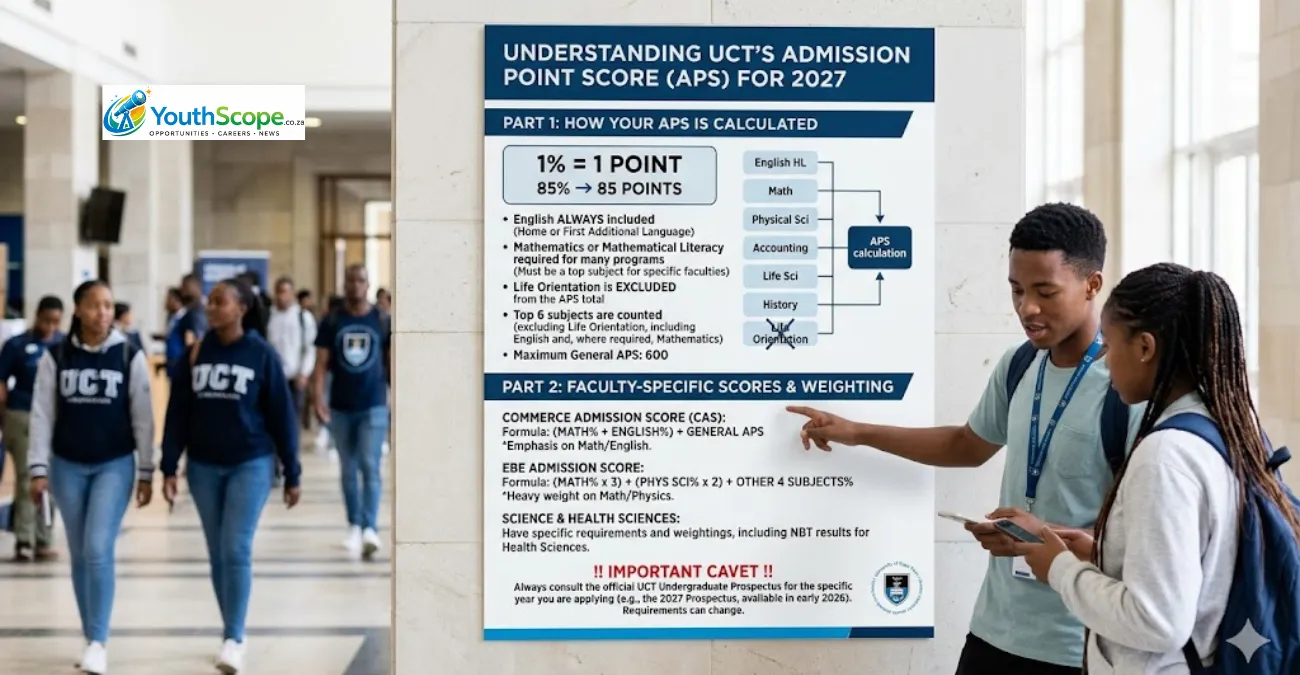
UCT APS Calculator 2027: How to Calculate Your University of Cape Town Admission Score

If you’re planning to apply to the University of Cape Town (UCT) for 2027, knowing how your Admission Point Score (APS) works is very important.

UCT uses a special APS system to assess applicants and decide whether they meet the entry requirements for different programmes. Understanding your score early can help you choose the right courses and improve your chances of admission.

What Is the UCT APS Calculator?

The UCT APS Calculator is a tool that helps students estimate their Admission Point Score using their National Senior Certificate (NSC) results.

It can help you:

  • Calculate your APS score
  • Check if you meet programme requirements
  • Compare courses before applying
  • Plan your university application wisely

Unlike many South African universities, UCT uses a score out of 600 points, not a simple level-based total.

How UCT APS Is Calculated

UCT calculates APS using your subject percentages, not achievement levels.

Key Rules

  • Each subject can contribute up to 100 points
  • Maximum total score is 600 points
  • Six subjects are counted
  • English is compulsory
  • Required subjects for your programme are included
  • Your best remaining subjects are added to make six
  • Life Orientation is excluded
  • Subjects below 40% are not counted

Example of UCT APS Calculation

Suppose your results are:

  • English: 70%
  • Mathematics: 65%
  • Physical Sciences: 60%
  • Life Sciences: 68%
  • Geography: 72%
  • Business Studies: 66%

APS Total

70 + 65 + 60 + 68 + 72 + 66 = 401

Your final UCT APS score = 401 out of 600

Why Your APS Matters at UCT

Your APS score helps determine:

  • Whether you qualify for a programme
  • How competitive your application is
  • Your chances of getting into popular courses

Because UCT is one of South Africa’s top universities, meeting only the minimum requirement may not always guarantee admission.

UCT Programmes and Typical APS Expectations

Different faculties have different standards.

Commerce and Humanities

  • Moderate APS requirements
  • Strong English performance often important

Science and Engineering

  • Higher APS required
  • Mathematics usually essential

Health Sciences

  • Very competitive APS
  • Strong marks in Maths and Sciences needed

Always check the latest official admission requirements for your chosen course.

How to Use the UCT APS Calculator

Follow these easy steps:

  1. Select your faculty
  2. Choose your programme
  3. Enter your subject percentages
  4. Click calculate
  5. View your APS instantly

CLICK HERE TO DISPLAY THE CALCULATOR

Tips to Improve Your APS

To strengthen your university application:

  • Focus on English and Mathematics
  • Aim for 70%+ in competitive courses
  • Improve your top six subjects
  • Choose backup programmes
  • Apply as early as possible

Final Thoughts

The UCT APS Calculator for 2027 is one of the best tools for future applicants. It gives you a clear idea of whether you qualify and how competitive your application may be.

Before applying, calculate your APS and compare it with the entry requirements of your preferred programme. This can save time, reduce stress, and help you make smarter application choices.

SASSA Grant Update 2026: What Young People Need to Know This Month

SASSA grants remain an important source of support for millions of South Africans, especially young people who depend on the SRD grant or live in households receiving social assistance. This month’s update includes key payment information, eligibility reminders, and important system changes.

New SASSA Payment Updates for April 2026

SASSA has confirmed that grant payments continue to follow a structured monthly schedule. Different grants are paid on different days to reduce system delays and long queues.

Typical payment order includes:

  • Older Persons Grant (first)
  • Disability Grant (second)
  • Children’s and other grants (last phase)
  • SRD R370 grant (paid in batches later in the month)

SRD payments for April 2026 are being processed between 24–30 April in batches, depending on approval status.

SRD R370 Grant: What Young People Should Know

The SRD (Social Relief of Distress) grant is the main SASSA support program used by many unemployed young people.

Key facts:

  • Monthly amount: R370
  • Paid to eligible unemployed individuals
  • Payments depend on monthly verification
  • Status checks determine approval or delay

Even if approved, payment dates may differ because funds are released in cycles throughout the month.

Grant Amount Changes (2026 Update)

From April 2026, most permanent grants increased slightly due to the national budget adjustment.

Some updated examples:

  • Older Persons Grant: around R2,400
  • Disability Grant: around R2,400
  • Child Support Grant: around R580

The SRD grant remains unchanged at R370.

Common Reasons for Delays or “Pending” Status

Many young applicants experience delays. This does not always mean rejection.

Common reasons include:

  • Bank account not verified
  • Income detected above threshold
  • Incorrect or outdated personal details
  • System verification delays
  • Identity mismatches

If your status is “pending,” it usually means your application is still being processed.

Important Rules for Young Applicants

To avoid problems with your SASSA application:

  • Always use your own bank account
  • Keep your ID and contact details updated
  • Do not share OTP codes with anyone
  • Apply only through official SASSA channels
  • Avoid paying anyone claiming they can “speed up” approval

You Can Also Check:

Why SASSA Matters for Youth

For many young South Africans, especially those unemployed, SASSA support helps with:

  • Transport costs for job searching
  • Basic food needs
  • Data and communication expenses
  • Temporary financial relief

Although it is not a long-term income solution, it plays a critical role in survival while people search for work.

Final Thoughts

SASSA grants continue to provide essential support, especially for young people facing unemployment challenges. Staying updated on payment dates, eligibility rules, and application status can help you avoid delays and make informed decisions each month.

NSFAS 2026 Updates – Funding Requirements and Application Information

Introduction

The National Student Financial Aid Scheme (NSFAS) remains one of the most important funding opportunities for students in South Africa. The NSFAS 2026 cycle has been a major focus for matriculants, university applicants, and TVET college students seeking financial support for higher education.

NSFAS helps qualifying students cover study costs such as tuition, accommodation, transport, learning materials, and living allowances. For many families, this funding makes tertiary education possible.

If you are planning to study in 2026, this guide explains the latest NSFAS updates, eligibility requirements, application process, and important deadlines.

What is NSFAS?

NSFAS is a government-funded bursary scheme that supports financially eligible South African students who study at public universities and public TVET colleges.

Funding is aimed at students who cannot afford tertiary education and meet the academic and financial criteria set each year.

NSFAS 2026 Application Updates

According to official updates, NSFAS opened applications for the 2026 academic year in late 2025 and later announced that applications had closed. Students are advised to monitor their myNSFAS accounts for funding outcomes and additional document requests.

Applicants can track their funding progress online using the official myNSFAS portal.

Who Qualifies for NSFAS 2026?

To qualify for NSFAS funding in 2026, applicants generally must meet the following requirements:

1. Citizenship Requirements

You must be:

  • A South African citizen
  • In some cases, approved permanent residents or qualifying groups may be considered

2. Institution Requirements

You must be accepted or intending to study at:

  • A public university in South Africa
  • A public TVET college

Private institutions are generally not funded through standard NSFAS bursary support.

3. Financial Requirements

Funding is mainly for students from low-income and working-class households. Means testing is used to determine eligibility.

4. Academic Requirements

You should meet the minimum academic entry requirements of your chosen institution and maintain satisfactory academic progress to continue receiving funding.

What Does NSFAS Cover in 2026?

Approved students may receive support for:

University Students

  • Tuition fees
  • Registration-related approved costs
  • Accommodation (subject to rules)
  • Transport allowance where applicable
  • Learning materials allowance
  • Living or personal care support

TVET College Students

  • Tuition
  • Accommodation or transport (where applicable)
  • Learning materials
  • Meals or related allowances depending on approved structure

Allowance rates may be reviewed annually.

How to Apply for NSFAS 2026

Applications are handled online through the official myNSFAS system.

Step 1: Create a myNSFAS Account

Go to the official portal and register using:

  • South African ID number
  • Your own cellphone number
  • Valid email address

Step 2: Complete the Application Form

Fill in:

  • Personal details
  • Household information
  • Institution details
  • Course information

Step 3: Upload Supporting Documents

Depending on your profile, required documents may include:

  • ID document
  • Consent form
  • Proof of income (if requested)
  • Parent/guardian details
  • Supporting legal documents if applicable

NSFAS notes that document requirements depend on the application type.

Step 4: Submit and Save Reference

After submitting, keep your reference details and monitor status updates.

How to Check NSFAS Status

Students can log in to the myNSFAS portal and use the “Track Funding Progress” feature.

Common statuses include:

  • Submitted
  • Under Review
  • Awaiting Documents
  • Approved
  • Rejected

NSFAS has stated that application outcomes are communicated through the portal.

Common Reasons Applications Get Delayed

Many students face delays because of:

  • Incorrect ID details
  • Unclear uploaded documents
  • Wrong contact information
  • Missing supporting forms
  • Institution registration not confirmed

Always double-check details before submitting.

Important NSFAS Safety Warning

NSFAS has warned students not to share passwords or login details. Only use official NSFAS platforms and never pay anyone to “approve” your funding.

Why NSFAS Matters in South Africa

NSFAS continues to help thousands of students access higher education who might otherwise be unable to study. It supports:

  • Youth development
  • Skills training
  • Graduate employability
  • Access to university and college education

You can also Check:

FAQ – NSFAS 2026 Updates

1. Is NSFAS a loan or bursary?

For many qualifying students, NSFAS support is bursary-based depending on current policy.

2. Can I apply before matric results are released?

Often yes, depending on the application cycle and institution requirements.

3. Does NSFAS fund private colleges?

Generally, standard NSFAS funding focuses on public universities and public TVET colleges.

4. How do I know if I am approved?

Check your myNSFAS portal regularly.

5. Can I reapply if rejected before?

Yes, many students can reapply if they still meet the criteria.

6. What if I forgot my password?

Use the password reset option on the myNSFAS portal.

Conclusion

The NSFAS 2026 funding cycle remains a critical opportunity for South African students seeking affordable access to tertiary education. If you meet the financial and academic requirements, ensure your documents are ready, apply through official channels, and check your status regularly.

For many students, NSFAS can be the key to starting and completing higher education successfully.

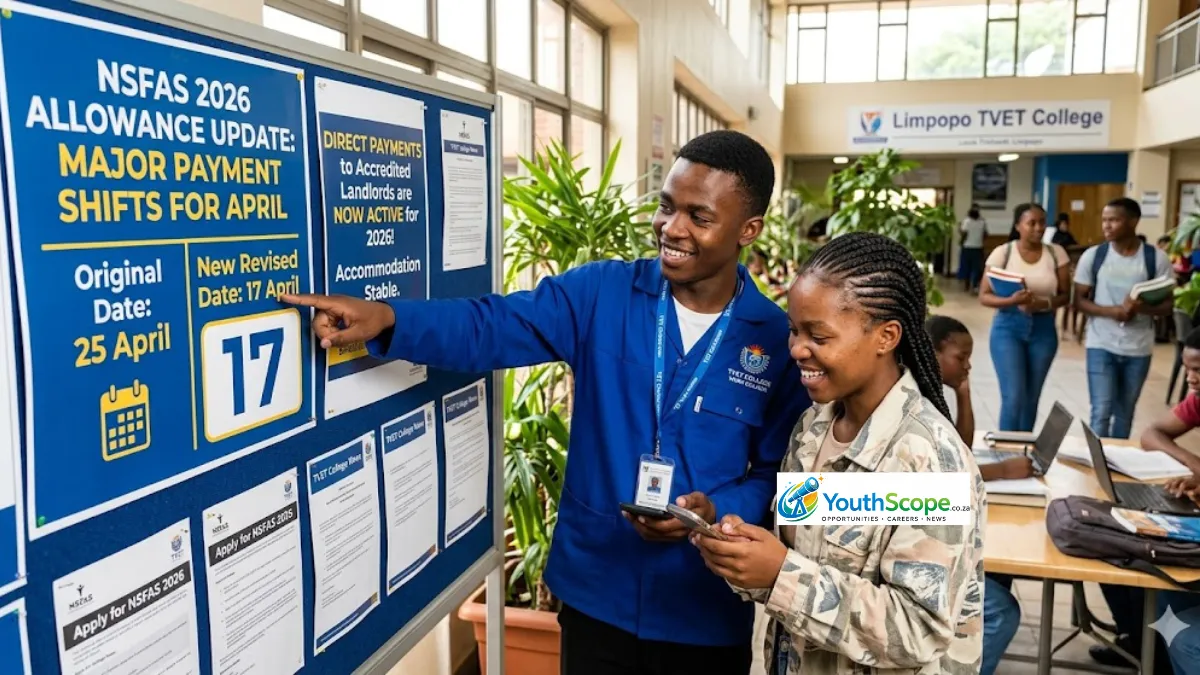
NSFAS 2026 Allowance Update: Major Payment Shifts for April

The National Student Financial Aid Scheme (NSFAS) has implemented a revised payment structure for 2026 to ensure smoother transitions between semesters. The most significant news for April 2026 is a major change to the payment date, which will require students to adjust their budgets immediately.

The April 2026 “Early Payment” Shift

For TVET college students, the standard payment date has been officially moved forward.

  • Original Payment Date: 25 April 2026
  • New Payment Date: 17 April 2026
  • The Reason: This 8-day advancement is intended to provide students with earlier access to funds for mid-semester expenses, though it creates a longer “gap” until the May disbursement.

2026 Official Allowance Payment Schedule

Most universities and TVET colleges have standardized their monthly cycles for the remainder of the 2026 academic year.

Monthly Disbursement Targets

Institution TypeStandard Payment Date
TVET Colleges25th of every month (except April)
Traditional Universities30th of every month
UNISA (Distance)29th of every month

Remaining 2026 Payment Cycles

According to the latest 2026 funding cycle documents, the “Cycle” dates for general disbursements are as follows:

  • Cycle 4: Monday, 04 May 2026
  • Cycle 5: Monday, 01 June 2026
  • Cycle 6: Monday, 06 July 2026
  • Cycle 7: Monday, 03 August 2026
  • Cycle 8: Monday, 31 August 2026
  • Cycle 9: Monday, 05 October 2026
  • Cycle 10 (Final): Monday, 02 November 2026

NSFAS 2026 Allowance Amounts

The 2026 annual totals have seen a slight adjustment to account for inflation. Students can expect the following estimated yearly breakdowns (split into 10 monthly installments):

  • Learning Material (Book) Allowance: Up to R5,460 (usually a once-off payment at the start of the year).
  • Living Allowance: Approximately R17,160 per year.
  • Personal Care Allowance (TVET): Approximately R3,167 per year.
  • Accommodation: * Metro: Up to R52,000 per year.
    • Non-Metro: Up to R42,640 per year.

You can also Check:

Critical To-Do List for Students

To avoid the “Payment Pending” status on your portal, ensure these three things are updated:

  1. Bank Account Verification: NSFAS now pays TVET allowances directly into personal bank accounts rather than through third-party “fintech” apps alone. Ensure your banking details on the myNSFAS portal match your ID exactly.
  2. Registration Data: Payments are only triggered once your institution (University or TVET) uploads your 2026 registration data. If your status still says “Funding Eligible” but not “Paid,” visit your campus Financial Aid office.
  3. The “Early Pay” Budget: Since the April payment arrives on the 17th, you must make it last until May 4th. Avoid “luxury” spending in the first week to cover transport and food for the extended month-end period.

FAQ

Why haven’t I received my April allowance yet?

If your registration was submitted late (after the April cut-off), your payment will be rolled over to the next “payment run,” which typically happens on the 14th of the following month.

Is the direct payment system still using eZaga/Norraco?

In 2026, NSFAS has transitioned toward more university-led distribution and direct bank transfers to minimize service fees. Check with your specific institution to see if they are using an internal system or the NSFAS direct bank upload.

Does NSFAS pay during the June/July holidays?

Yes. The 10-installment cycle covers the academic year, including the mid-year break, to assist with ongoing accommodation and living costs.

Unemployed and Qualified? NYDA is Calling All Graduates to Join Its National Opportunity Database

Get On the Map: NYDA National Unemployed Graduate Database 2026

For many South African graduates, the journey doesn’t end at graduation—it often pauses there. The “experience gap” and a lack of professional networks can make a hard-earned degree feel invisible to the job market. The National Youth Development Agency (NYDA) is addressing this by calling on all unemployed graduates to register on its national database.

This is not a single job vacancy; it is a centralized talent pipeline. By registering, you are making your qualifications visible to government initiatives, private sector partners, and entrepreneurship incubators looking for fresh talent in 2026.

What is the NYDA Graduate Database?

Think of this as a specialized “LinkedIn” for the public sector and youth development. NYDA uses this database to “match” qualified youth with specific interventions. Instead of you searching for a needle in a haystack, the NYDA brings the opportunities to you based on your registered profile.

Who Should Register?

To ensure the database is effective, NYDA has set specific eligibility criteria. You are encouraged to sign up if you meet the following:

  • Age: You must be between 18 and 35 years old.
  • Citizenship: You must be a South African citizen.
  • Education: You must have a completed post-Matric qualification (Higher Certificate, Diploma, or Degree).
  • Employment Status: You must be currently unemployed.

What Kind of Opportunities Are Linked?

Registration puts you in line for more than just a 9-to-5 job. The database is a gateway to:

  • Employment Placements: Internships, learnerships, and entry-level roles in various government and private sectors.
  • Entrepreneurship Support: Access to NYDA grants, business mentorship, and voucher programmes for start-ups.
  • Skills Development: Specialized training in high-growth areas like digital literacy, financial management, and artisan trades.
  • Job Preparedness: Invitations to workshops on CV writing, interview coaching, and professional branding.

Registration Checklist: What You’ll Need

When you log on to the portal, you will be asked to provide detailed information. Have these ready to ensure your profile is “search-ready”:

  1. Personal Information: Your ID number and up-to-date contact details.
  2. Educational Background: Details of your institution, qualification name, and year of completion.
  3. Updated CV: A digital copy (PDF is best) that highlights your skills.
  4. Sector Interests: Be ready to choose which industries you are most interested in (e.g., Finance, ICT, Agriculture, or Education).
  5. POPIA Consent: You will need to agree to let NYDA process your data according to the Protection of Personal Information Act.

How to Register

The NYDA has made the process digital and accessible. You can join the database through two main routes:

  • The Web Portal: Visit the official NYDA registration portal online.
  • QR Code: Scan the official QR code found on NYDA’s 2026 posters and social media pages to be taken directly to the sign-up form.
DetailRequirement
Target GroupUnemployed Graduates
Age Limit18–35
QualificationPost-Matric (NQF 5 and above)
CostFree Registration

Export to Sheets

Frequently Asked Questions

Does registration guarantee me a job?

No. Registration makes you visible to the agency and its partners. While it significantly improves your chances of being contacted for an opportunity, the final selection for any job or grant depends on your performance during interviews or assessments.

Can I register if I have a pending result?

NYDA typically requires a completed qualification. If you have a “letter of completion” from your institution but are waiting for your final certificate, you can usually still register.

How often should I update my profile?

You should log in to update your profile whenever you gain a new skill, complete a short course, or change your phone number. An outdated profile is an invisible profile.

Is my data safe?

Yes. NYDA is legally bound by the POPIA Act, meaning your information can only be used for the purpose of connecting you to developmental opportunities. It cannot be sold or shared with unauthorized third parties.

You can also Check:

Final Thoughts: A Proactive Step Forward

In a competitive economy, being “qualified” is just the baseline. You also need to be findable. Registering on the NYDA database is a low-effort, high-reward move that ensures you are in the room when the next round of 2026 opportunities is being discussed.

Don’t remain a hidden talent. Register on the NYDA portal today and make your qualification work for you.

Have you already completed your registration, or are you waiting for your final transcript to be issued?

Matric Rewrite 2026: How to Register for May/June Exams (NSC & SC Guide)

Matric Rewrite 2026: Improve Your Results This Year

If you’re not satisfied with your matric results, rewriting your exams can be a smart move. The Department of Basic Education has officially opened registrations for the May/June 2026 matric rewrite exams.

This is your chance to upgrade your marks, qualify for university, or unlock new career opportunities.

Important Matric Rewrite Dates for 2026

  • May/June Rewrite Registration Deadline: 6 February 2026
  • November 2026 Exam Registration Deadline: 13 March 2026

📌 Important Update:
The old February/March supplementary exams have been phased out. The May/June exams are now your first rewrite opportunity.

Who Can Apply for Matric Rewrites?

There are two main categories:

1. NSC (National Senior Certificate) Candidates

  • Must register in person
  • Register at:
    • Your school
    • Nearest district office

2. SC (Senior Certificate) Candidates

  • Can register:
    • At a district office
    • Online via e-Services South Africa

Useful YouthScope Links:

 Note:
SC candidates can only write in May/June, not November.

How to Register for Matric Rewrite 2026

For NSC Candidates:

  1. Visit your school or district office
  2. Complete the registration form
  3. Submit required documents

For SC Candidates:

  1. Go to your nearest district office OR
  2. Apply online via e-Services
  3. Complete your application

Why Rewrite Matric?

Rewriting can help you:

  • Improve your marks
  • Qualify for university admission
  • Access bursaries like National Student Financial Aid Scheme
  • Increase job opportunities

Many students upgrade their results and go on to successful careers.

Different Matric Pass Levels Explained

Understanding pass levels helps you set goals when rewriting.

Bachelor’s Pass

  • 50% in 4–5 subjects (including Life Orientation)
  • 30% in 2 other subjects
  • Fail only 1 subject

Allows entry into universities for degrees like law, medicine, etc.

Diploma Pass

  • 40% in 5 subjects (including Life Orientation)
  • 30% in 2 subjects
  • Fail only 1 subject

Allows study at universities of technology and colleges.

Higher Certificate Pass

  • 40% in Home Language
  • 40% in 2 other subjects
  • 30% in 3 subjects

Allows study at TVET and some private colleges.

Fail

  • Failing 2 subjects (0–29%) = overall fail

⚠️ But you can always rewrite and improve.

Important Things to Know

  • You can rewrite specific subjects or the full matric
  • Only shortlisted registrations may be processed depending on requirements
  • Late applications are usually not accepted

Tips to Pass Your Matric Rewrite

1. Focus on Weak Subjects

Target the subjects that lowered your overall result.

2. Create a Study Plan

Break down your time before exams into manageable goals.

3. Use Past Papers

Practice with previous exam papers to understand question patterns.

4. Seek Help

  • Teachers
  • Tutors
  • Study groups

What Happens After You Improve Your Results?

Once you pass or upgrade your marks, you can:

  • Apply to universities
  • Apply to TVET colleges
  • Qualify for funding like NSFAS
  • Enter the job market with better opportunities

Recent Posts

  1. 2027 University Applications Now Open in South Africa: Full List & Deadlines
  2. TUT4Life Login Guide 2026: How to Access Your Tshwane University of Technology Student Email
  3. SANParks Graduate Internship Programme 2026: Work at Kruger National Park (Stipend: R6,355.69 – R9,088.37 per month)
  4. Shoprite Graduate Programme 2026: Transport & Fleet Opportunity (Apply Before 22 March)
  5. Deloitte Graduate Programme 2026 / 2027: How to Apply, Requirements & Career Opportunities

FAQs About Matric Rewrite 2026

1. Can I rewrite only one subject?

Yes, you can rewrite specific subjects.

2. Are supplementary exams still available?

No, they have been replaced by the May/June exams.

3. Can I write in November instead?

NSC candidates can, but SC candidates cannot.

4. Where do I register?

At your school, district office, or online (for SC candidates).

5. Is rewriting matric worth it?

Yes, it can significantly improve your future opportunities.

Final Thoughts

Failing or underperforming in matric is not the end—it’s a second chance.

The Matric Rewrite 2026 gives you the opportunity to improve your results and move forward with confidence.

Apply Before the Deadline

Don’t miss your chance—register early and start preparing today.

2027 University Applications Now Open in South Africa: Full List & Deadlines

2027 University Applications Are Now Open – Start Early

If you’re planning to start university in 2027, now is the time to act. Several South African universities have already opened applications, while many others will open in the coming months.

Applying early gives you a better chance of acceptance, especially for competitive programmes.

Universities Open for 2027 Applications (March 2026)

From 1 March, applications are already open at:

  • University of the Witwatersrand (Wits)

KZN Universities (Apply via CAO)

The following universities require applications through the
Central Applications Office:

  • Durban University of Technology (DUT)
  • Mangosuthu University of Technology
  • University of Zululand
  • University of KwaZulu-Natal

Universities Opening in April 2026

The following institutions are expected to open applications in April:

  • Tshwane University of Technology
  • University of Johannesburg
  • University of Limpopo
  • Central University of Technology
  • North-West University
  • University of the Western Cape
  • University of Cape Town
  • University of the Free State
  • University of Pretoria
  • Rhodes University
  • Nelson Mandela University
  • Sefako Makgatho Health Sciences University
  • Stellenbosch University
  • Sol Plaatje University

Universities Opening Later in 2026

May 2026

  • University of Venda (Univen)
  • Cape Peninsula University of Technology

June 2026

  • Vaal University of Technology
  • University of Mpumalanga
  • Walter Sisulu University
  • University of Fort Hare

September 2026

  • University of South Africa (UNISA)

Useful YouthScope Links:

What is the CAO and How Does It Work?

The Central Applications Office (CAO) is a centralized system used mainly by universities in KwaZulu-Natal.

Instead of applying to each university separately, you can:

  • Submit one application
  • Apply to multiple institutions and courses

National Benchmark Tests (NBTs)

Some universities require the
National Benchmark Tests (NBTs) as part of the application process.

NBTs assess:

  • Academic readiness
  • Maths and language skills

📌 Tip: Book and write your NBTs early to avoid delays.

NSFAS Funding for 2027 Students

The National Student Financial Aid Scheme (NSFAS) provides funding to eligible students at all 26 public universities.

Funding Criteria:

  • Household income below R350,000/year → Full bursary
  • Income R350,000 – R600,000/year → Student loan

What NSFAS Covers:

  • Tuition fees
  • Accommodation
  • Food and transport
  • Study materials

NSFAS applications usually open later in the year.

Important Application Tips

1. Apply Early

University spaces fill up quickly—especially for competitive courses.

2. Apply Before NSFAS Opens

You don’t need NSFAS approval to apply for university.

Apply first, then apply for NSFAS later.

3. Apply to Multiple Universities

This increases your chances of acceptance.

4. Prepare Your Documents

  • ID copy
  • Matric results / Grade 11 results
  • Proof of payment (if required)

Why You Should Apply Now

  • Secure your place early
  • Avoid last-minute stress
  • Get time to plan funding and accommodation

💡 Applying early does not lock you in—you can still decline offers later.

Recent Posts

FAQs About 2027 University Applications

1. When should I apply for 2027 university admission?

As early as March 2026 when applications open.

2. Can I apply without final matric results?

Yes, universities use Grade 11 or mid-year Grade 12 results.

3. Do all universities use CAO?

No, only certain universities (mainly in KZN).

4. When does NSFAS open?

Usually in the last quarter of the year.

5. Can I change my course after applying?

Yes, most universities allow course changes before final acceptance.

Final Thoughts

Applying for university in South Africa is competitive, and early preparation is key.

With 2027 applications already opening, now is the perfect time to secure your future.

Start Your Application Today

Don’t wait—begin applying now to increase your chances of getting into your preferred university and programme

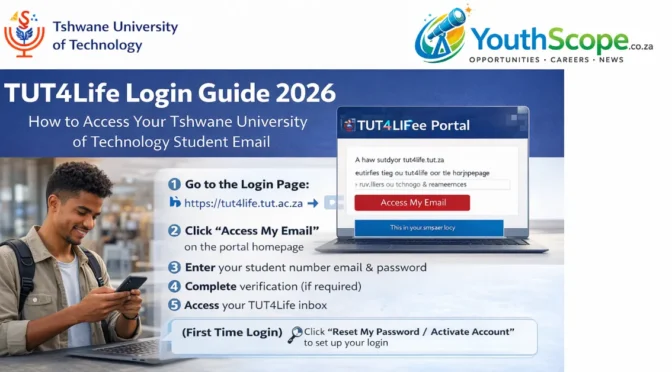
TUT4Life Login Guide 2026: How to Access Your Tshwane University of Technology Student Email

What is TUT4Life?

Tshwane University of Technology (TUT) introduced TUT4Life as an official student email system to support communication, learning, and academic updates.

Established in 2004 after the merger of three Technikons, TUT has grown into one of South Africa’s leading universities of technology, focusing on innovation, inclusivity, and practical learning.

Why TUT4Life is Important for Students

Your TUT4Life email account is more than just an inbox—it’s your official communication channel with the university.

Useful YouthScope Links:

With TUT4Life, you can:

  • Receive important university announcements
  • Access Blackboard notifications
  • Communicate with lecturers and fellow students
  • Stay updated on academic activities

 Important: Missing emails can mean missing deadlines, results, or critical updates.

How to Access TUT4Life Email (Step-by-Step Guide)

Follow these simple steps to log in to your TUT4Life account:

Step 1: Visit the TUT4Life Portal

Go to the official TUT4Life login page.

Step 2: Click on “Access my TUT4Life Email”

Step 3: Enter Your Student Email

  • Use the email address provided by TUT

Step 4: Enter Your Password

  • Type your password and click Submit

Step 5: Access Your Inbox

You will now have full access to your student email and notifications.

Common TUT4Life Login Issues (And Fixes)

1. Forgot Password

  • Use the password reset option on the login page
  • Contact TUT IT support if needed

2. Incorrect Email Format

  • Ensure you’re using your official student email

3. Login Page Not Loading

  • Check your internet connection
  • Try a different browser

4. Account Locked

  • Wait and retry or contact IT services

TUT Faculties You Can Access via TUT4Life

Once logged in, students can access information across TUT’s faculties, including:

  • Science
  • Engineering and Technology
  • Business and Management
  • Education
  • Humanities
  • Arts

About Tshwane University of Technology (TUT)

Tshwane University of Technology is known for:

  • Practical, career-focused education
  • Use of innovative technology in learning
  • Promoting access to higher education
  • Addressing unemployment and inequality

The university equips students with skills aligned to real-world industry needs.

Tips for Using TUT4Life Effectively

  • Check your email daily
  • Enable notifications on your phone
  • Keep your login details secure
  • Use it for all academic communication

 Pro Tip: Link your TUT4Life email to your mobile device for instant updates.

Recent Posts

FAQs About TUT4Life

1. What is TUT4Life used for?

It is your official student email used for communication, updates, and academic notifications.

2. Can I access TUT4Life on my phone?

Yes, you can log in via mobile browser or email apps.

3. What if I forget my password?

Use the password reset option or contact TUT support.

4. Is TUT4Life mandatory?

Yes, all students must use it for official communication.

5. Does TUT4Life include Blackboard notifications?

Yes, Blackboard updates are sent directly to your TUT4Life email.

Final Thoughts

The TUT4Life email system is an essential tool for every student at Tshwane University of Technology.

By checking it regularly and using it effectively, you can stay informed, organised, and ahead in your academic journey.

Start Using TUT4Life Today

Make sure you log in, stay updated, and never miss important university communication.

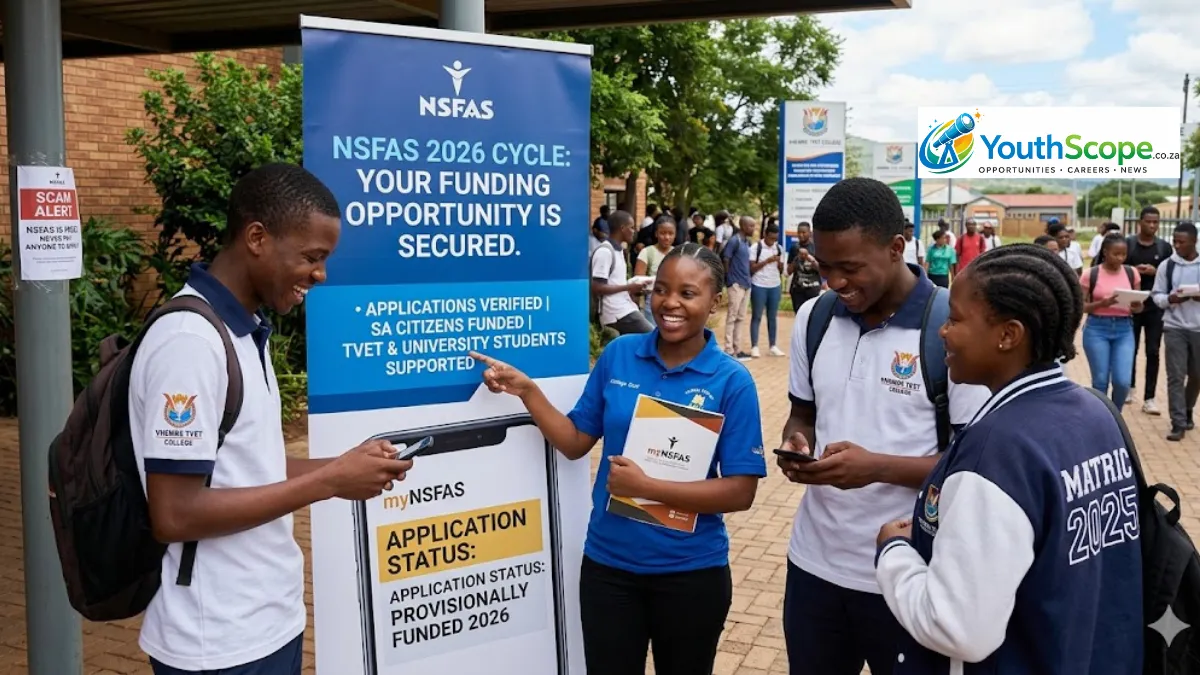
NSFAS 2026 Update: Over 1 Million Students Approved for Funding in South Africa

NSFAS 2026: Major Funding Boost for Over 1 Million Students

More than 1 million South African students will receive financial support for the 2026 academic year through the
National Student Financial Aid Scheme.

This announcement brings relief to thousands of families and confirms that universities and TVET colleges can proceed with registrations and admissions.

For many students, this funding is the difference between studying and missing out on higher education.

Strong Support for New and Returning Students

The 2026 funding cycle supports both:

  • First-time applicants entering higher education
  • Returning students who meet academic requirements

Balanced Funding Approach

  • A large portion of funding goes to new students
  • Returning students retain funding based on academic performance

 Key Insight:
This system ensures greater access while maintaining accountability.

Early Processing Improves 2026 Registration

For 2026, NSFAS processed a high volume of applications earlier than usual.

Why This Matters

  • Reduces registration delays
  • Allows institutions to plan better
  • Helps students secure placement faster

This is a major improvement compared to previous years.

Why Some Applications Were Rejected

Despite high approval rates, some applications were unsuccessful.

Common Reasons

  • Missing documents
  • Not meeting financial criteria
  • Not meeting academic requirements

⚠️ Important:
Incomplete applications are one of the biggest reasons students lose funding opportunities.

Academic Performance Still Matters

For returning students, funding is not automatic.

Instead, institutions evaluate:

  • Academic progress
  • Course completion rates

Students who fail to meet requirements risk losing funding.

However, support is still available through appeals.

Useful YouthScope Links:

NSFAS Appeals Process 2026

Students whose applications were rejected or incomplete can still apply for reconsideration.

How Appeals Work

  • Submit missing documents
  • Provide valid reasons for reconsideration
  • Apply within the official deadline

 Act Fast:
Late appeals are usually not accepted.

What NSFAS Funding Covers

Approved students receive comprehensive financial support.

Covered Costs

  • Tuition fees
  • Accommodation
  • Meals
  • Transport allowance
  • Learning materials

Payments are managed through institutions based on academic schedules.

Universities and TVET Colleges Ready for 2026

With funding confirmed, institutions across South Africa are now:

  • Opening registrations
  • Finalising admissions
  • Preparing orientation programmes

This ensures a smoother start to the academic year.

New Eligibility and System Improvements

NSFAS continues to refine its system to improve efficiency.

Key Improvements for 2026

  • Faster application processing
  • Better communication with students
  • More structured funding approvals

💡 These changes aim to reduce uncertainty and improve access.

What This Means for Students

Benefits

  • Increased access to higher education
  • Reduced financial stress
  • Improved registration process

Challenges

  • Strict academic requirements
  • Competitive application process
  • Need for complete documentation

Why This Is a Big Step for South Africa

The approval of funding for over 1 million students highlights:

  • Government commitment to education
  • Increased access to skills development
  • Support for future workforce growth

Education remains one of the most powerful tools for economic development.

Recent Posts

Frequently Asked Questions (FAQs)

1. How many students are funded by NSFAS in 2026?

Over 1 million students have been approved.

2. Does NSFAS fund both new and returning students?

Yes, as long as eligibility and academic requirements are met.

3. What does NSFAS funding cover?

Tuition, accommodation, food, transport, and study materials.

4. Can I appeal if my application is rejected?

Yes, but you must submit your appeal within the deadline.

5. When will payments be made?

Payments are distributed through institutions during the academic year.

Final Thoughts

The NSFAS 2026 funding update marks a major milestone for higher education in South Africa.

With over 1 million students funded, improved processing systems, and better access to financial aid, the 2026 academic year is set to be more efficient and inclusive.

Don’t Miss Your Opportunity

If you applied:

  • Check your application status
  • Submit appeals if needed
  • Prepare for registration

Taking action early could secure your place in 2026.