
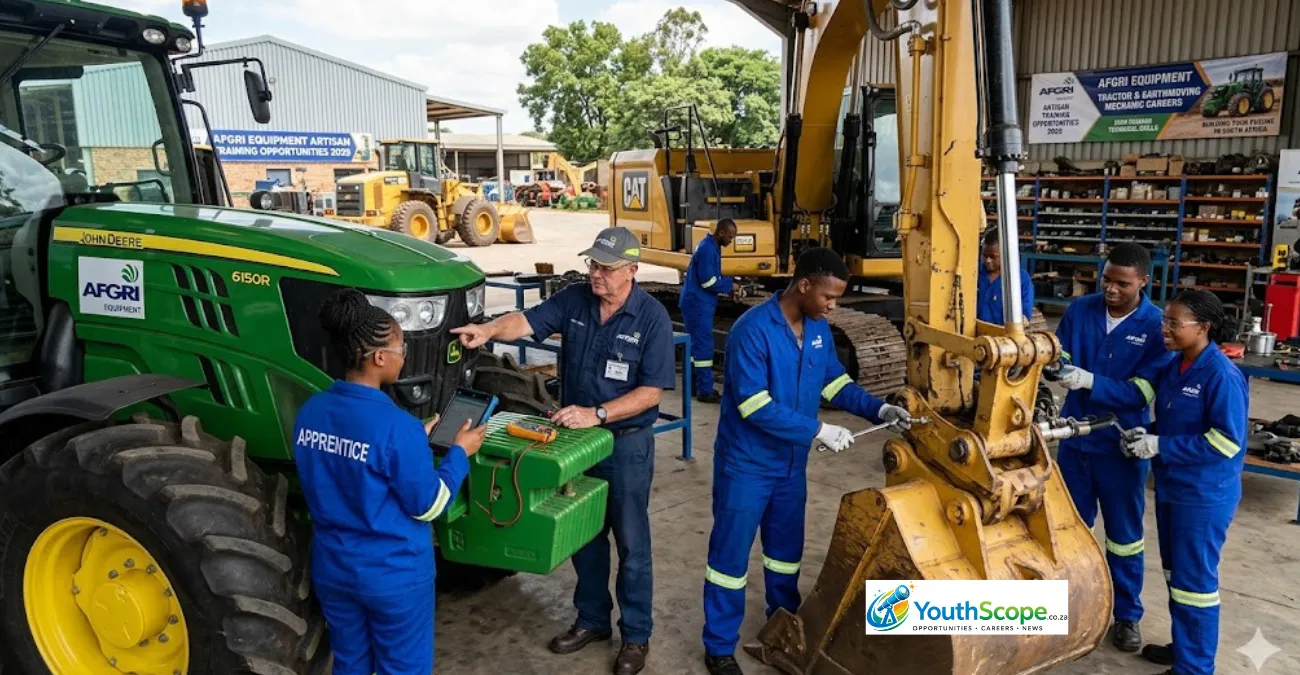
South Africa’s agricultural and earthmoving sectors continue to need qualified artisans. For young people interested in becoming a tractor mechanic or earthmoving mechanic, the AFGRI Equipment Artisan Training Opportunities 2026 offer a valuable route into a high-demand technical career.
This structured programme combines workplace experience, formal technical learning, and recognised trade development pathways supported by SETA authorities.
It is an excellent option for learners who prefer practical careers over university study.
Quick Overview
- Programme: AFGRI Equipment Artisan Training Opportunities 2026
- Reference Number: AO-2345
- Number of Posts: 40
- Closing Date: 30 September 2026
- Training Duration: 3 Years
- Maximum Contract Period: 4 Years
- Probation Period: First 6 Months
Training Fields
- Tractor Mechanic
- Earthmoving Mechanic
Training Authorities
- AgriSETA
- MerSETA
Minimum Qualification
- Grade 12 with Mathematics or Technical Mathematics
Other Requirements
- Valid driver’s licence required
- Training costs covered if subjects are passed
- Work-back period applies after completion
About the AFGRI Artisan Training Programme
The programme offers 3 years of structured in-service training, allowing apprentices to develop practical skills while learning in real workshop environments.
Training Includes
Workplace Technical Exposure
- Equipment repairs
- Preventative maintenance
- Fault finding and diagnostics
- Spare parts handling
- Workshop systems and procedures
Formal Learning Phases
- Institute attendance
- Distance learning modules
- Supplier product training
- Internal AFGRI technical support
Additional Support
- Specialist mentoring
- Assessments
- Technical progress tracking
Some phases may include Saturday classes depending on training schedules.
Understanding the 6-Month Probation Period
The first six months serve as a trial period for both AFGRI and the apprentice.
AFGRI May Assess:
- Discipline
- Technical potential
- Teamwork
- Work attitude
Apprentices May Assess:
- Career suitability
- Workshop environment
- Learning expectations
Either side may withdraw during probation without penalties.
SETA Support and Qualification Value
The programme is backed by:
- AgriSETA
- MerSETA
These training authorities help ensure:
- National training standards
- Recognised qualifications
- Industry-relevant skills
- Pathways to trade certification
This can improve long-term employability.
What You Will Learn
Successful apprentices receive training in:
Mechanical Diagnostics
Identify machine faults and repair solutions.
Equipment Servicing
Routine maintenance of tractors and earthmoving equipment.
Workshop Systems
Tool usage, workflow processes, and safety procedures.
Customer Support
Communicating equipment issues with clients and operators.
Stock Control
Managing parts and workshop inventory.
Administration
Recording maintenance and service reports.
Duties of an Apprentice
During training, you may:
- Work toward qualifying as a tractor or earthmoving mechanic
- Assist with servicing machinery
- Support workshop operations
- Help with parts control
- Participate in stock systems
- Assist customers
- Complete workplace tasks and training requirements
Minimum Requirements
Applicants must have:
- Valid driver’s licence
- Good communication skills
- Basic admin skills
- Computer literacy
- Grade 12 with:
- English
- Mathematics or Technical Mathematics
Important:
Mathematical Literacy is not accepted.
Advantageous Subjects
These subjects may improve your chances:
- Engineering Science
- Physical Science
- Engineering Graphics and Design
- Diesel Trade Theory
- Motor Trade Theory
They are helpful but not compulsory.
Behavioural Qualities AFGRI Wants
Strong candidates are usually:
- Motivated
- Reliable
- Detail-focused
- Goal-driven
- Team players
- Willing to learn
- Comfortable under deadlines
Artisan training requires discipline and consistency.
Important Cost and Contract Rules
Training Is Covered If You Pass
However:
- Failed subjects must be repeated at your own cost
- Failed modules may delay qualification
- Work-back obligations apply after completion
If You Leave Early
You may be required to repay training costs.
Work-Back Example
- 3 years training = 3 years work-back period
Possible Training Locations
Apprentices may be placed at AFGRI branches across South Africa, including:
- Polokwane
- Bethlehem
- Brits
- Middelburg
- George
- Bellville
- Pietermaritzburg
- Empangeni
- Kempton Park
- Nelspruit
- Tzaneen
- Kokstad
Placement depends on business needs.
Applicants should be willing to relocate if necessary.
How to Apply
Submit your application before the deadline.
Tips for Applicants
This programme is ideal if you:
- Enjoy working with machinery
- Prefer hands-on learning
- Want a stable artisan career
- Like workshop environments
- Have technical curiosity
To Improve Your Chances:
- Revise basic mechanical concepts
- Highlight technical school subjects
- Prepare for screening questions
- Show motivation during interviews
Frequently Asked Questions
Is this a paid apprenticeship?
Apprenticeships often include structured training support and may include stipends depending on the phase.
Is Mathematical Literacy accepted?
No. Mathematics or Technical Mathematics is required.
Can I apply without a driver’s licence?
No. A valid licence is compulsory.
Will AFGRI cover training costs?
Yes, if you pass all required subjects.
Can I leave during training?
Yes, but repayment obligations may apply after probation.
Closing Date
30 September 2026

Mbalizuke Nkosi is the editorial voice behind YouthScope.co.za, a South African youth-focused platform dedicated to providing reliable information on opportunities, education, and career development. The platform serves students, graduates, job seekers, and young professionals by delivering accurate, timely, and easy-to-understand content.
Through informative and professionally curated content, YouthScope.co.za aims to equip young people with the knowledge and resources needed to make informed decisions about their education and future careers.
For inquiries or support, please contact admin@youthscope.co.za.