Category Archives: Career Guides

Popular SETA Learnerships for South African Youth in 2026

Looking for a way to gain skills, earn money, and boost your career — all at the same time?

SETA learnerships could be your golden opportunity.

Across South Africa, Sector Education and Training Authorities (SETAs) are helping young people gain real workplace experience while studying toward a recognised qualification. The best part? Many learnerships include a monthly stipend.

If you’re unemployed, recently matriculated, or looking to upskill, here are some of the most popular SETA learnerships in 2026.

1. Services SETA Learnerships

Perfect for youth interested in:

  • Business Administration
  • Office Management
  • Contact Centre Support
  • Project Management

These programmes are great if you enjoy working with people and want strong admin or corporate skills.

2. CETA Learnerships

Interested in building and construction?

CETA offers learnerships in:

  • Civil Engineering Construction
  • Plumbing
  • Electrical Work
  • Bricklaying

These skills are always in demand and can even help you start your own business one day.

3. MICT SETA Learnerships

Tech lovers, this one’s for you

Popular fields include:

  • IT Support
  • Software Development
  • Cybersecurity
  • Digital Marketing

As South Africa grows digitally, tech skills are becoming some of the most valuable in the job market.

4. W&RSETA Learnerships

Want experience in the retail world?

Opportunities include:

  • Retail Operations
  • Sales
  • Store Supervision
  • Supply Chain

Perfect if you enjoy fast-paced environments and working with customers.

5. HWSETA Learnerships

If you’re passionate about helping people, consider:

  • Community Health Work
  • Social Auxiliary Work
  • Child and Youth Care

These roles make a real difference in communities across South Africa.

QUICK LINKS:

Why Youth Should Consider a SETA Learnership

✔ Gain a nationally recognised qualification
✔ Earn a monthly stipend
✔ Get real workplace experience
✔ Improve your chances of permanent employment
✔ Build confidence and professional networks

For many young South Africans, a learnership is the first step toward financial independence.

Popular SETA Learnerships for South African Youth in 2026

How to Apply for SETA Learnerships

  1. Prepare your updated CV
  2. Get certified copies of your ID and qualifications
  3. Register on company career portals
  4. Check SETA websites regularly
  5. Apply early — spaces fill quickly

Pro tip: Follow companies and SETAs on social media for the latest openings.

Frequently Asked Questions (FAQ)

1. What is a SETA learnership?

A SETA learnership is a work-based learning programme that combines classroom study with practical workplace experience, leading to a registered qualification.

2. Who qualifies for a SETA learnership?

Most learnerships target unemployed South African youth aged 18–35. Requirements vary depending on the programme.

3. Do SETA learnerships pay?

Yes. Most learnerships offer a monthly stipend, but the amount differs by sector and employer.

4. How long do learnerships last?

They usually run for 12 months, but some technical programmes may last longer.

5. Can I get a job after completing a learnership?

While employment is not guaranteed, many learners are absorbed by the host company after successful completion.

Recent Posts

Information Literacy Learning Skills 2026: A Practical Guide for Academic and Career Success

In today’s digital world, information is everywhere. From social media feeds to academic journals and AI-generated content, we are constantly exposed to data, opinions, and headlines. But having access to information is not the same as understanding it.

That’s where information literacy learning skills become essential.

Information literacy is the ability to recognize when information is needed and to locate, evaluate, organize, and use that information effectively and ethically. These skills are critical for students, professionals, and anyone navigating modern life.

Let’s break it down in a practical, real-world way.

What Are Information Literacy Learning Skills?

Information literacy learning skills enable you to:

  • Identify what information you actually need
  • Find reliable and relevant sources
  • Evaluate accuracy and bias
  • Organize and synthesize findings
  • Use information ethically and legally
  • Communicate insights clearly

It’s not just about research papers. It applies to everyday decisions — from choosing a university course to verifying a viral news story.

In simple terms: Information literacy is thinking before believing, sharing, or applying information.

Why Information Literacy Matters More Than Ever

We live in a time where:

  • Anyone can publish content online
  • Misinformation spreads quickly
  • AI tools generate large volumes of text
  • Emotional headlines attract more clicks than facts

Without strong information literacy skills, people risk:

  • Believing false claims
  • Sharing misleading content
  • Making poor academic or career decisions
  • Producing weak research or reports

With strong information literacy skills, you become:

  • A confident researcher
  • A responsible digital citizen
  • A critical thinker
  • A lifelong learner

Core Information Literacy Skills (With Real Examples)

Information literacy is a process. Each step builds on the previous one.

1. Recognizing the Need for Information

This is the starting point. You must clearly define what you need to know.

Example:
A student realizes their assignment requires peer-reviewed journal articles, not blog posts. They refine their research question before searching.

Why it matters:
If you don’t clearly define your need, you waste time collecting irrelevant information.

2. Locating and Accessing Information

Once you know what you need, the next step is finding it efficiently.

This involves:

  • Using specific keywords
  • Applying search operators (AND, OR, NOT)
  • Accessing academic databases
  • Checking official websites

Example:
A university student uses Google Scholar and filters results by publication date to find recent research.

Why it matters:
Better search strategies lead to higher-quality results.

QUICK LINKS:

3. Evaluating Information Critically

Not all information is credible. Ask critical questions:

  • Who is the author?
  • Is there evidence provided?
  • Is it biased?
  • Is it up to date?
  • Does it answer your question?

Example:
Before sharing a viral news story, a reader checks multiple reputable news outlets to confirm accuracy.

Why it matters:
Critical evaluation prevents misinformation and strengthens your credibility.

4. Organizing and Synthesizing Information

After gathering information, you must structure it meaningfully.

This includes:

  • Taking organized notes
  • Comparing multiple sources
  • Identifying patterns or contradictions
  • Building clear arguments

Example:
An employee reviews several industry reports and combines the findings into one strategic proposal.

Why it matters:
Information without structure has little value.

5. Using Information Ethically and Legally

Ethical information use includes:

  • Avoiding plagiarism
  • Citing sources correctly (APA, MLA, Harvard)
  • Respecting copyright
  • Understanding Creative Commons licenses

Example:
A student paraphrases a source properly and includes in-text citations and a reference list.

Why it matters:
Ethical use protects your reputation and avoids academic or legal consequences.

6. Communicating Information Effectively

Finally, you must present information clearly for your audience.

This may include:

  • Academic essays
  • Business reports
  • Presentations
  • Social media posts
  • Policy briefs

Example:
A healthcare professional explains medical research in simple language so patients can understand it.

Why it matters:
Even excellent research loses impact if poorly communicated.

Information Literacy Learning Skills 2026

Real-Life Applications of Information Literacy

Academic Success

Students who evaluate sources carefully produce stronger assignments and achieve better grades.

Workplace Decision-Making

Managers who analyze multiple credible reports make data-driven decisions rather than relying on assumptions.

Digital Citizenship

Before sharing a controversial post, responsible users verify it through reputable sources.

Health and Personal Decisions

Individuals researching symptoms compare information from trusted health organizations before making decisions.

Common Information Literacy Mistakes

Many people struggle because they:

  • Rely on the first search result
  • Trust information without checking sources
  • Confuse opinion with fact
  • Ignore publication dates
  • Use only one source for complex topics
  • Forget to cite properly

Awareness of these mistakes is the first step toward improvement.

How to Improve Your Information Literacy Skills

You can strengthen your skills by:

  • Practicing advanced search techniques
  • Using academic databases
  • Learning citation styles
  • Comparing multiple sources
  • Asking critical questions about every claim
  • Taking short online research skills courses

Like any skill, information literacy improves with practice.

Frequently Asked Questions

Is information literacy only for students?

No. It is essential for professionals, entrepreneurs, and everyday decision-making.

How is information literacy different from digital literacy?

Digital literacy focuses on using technology.
Information literacy focuses on evaluating and using information critically.

Can social media be reliable?

Sometimes — but information should always be verified using reputable and independent sources.

Final Thoughts

Information literacy learning skills are not optional in today’s world. They are foundational to academic success, professional growth, and responsible citizenship.

The ability to think critically about information is a competitive advantage. Those who master it become stronger decision-makers, better communicators, and more informed members of society.

Information literacy is not about memorizing facts.
It is about learning how to learn — and applying knowledge responsibly for life.

Recent Posts

Full list of all 21 SETAs in South Africa (2026/2027). Learn how SETAs fund learnerships and internships.

Complete Guide to All 21 SETAs in South Africa (2026/2027)

If you’re serious about finding a learnership, internship, bursary, or skills programme in South Africa, understanding the SETA system is essential.

Sector Education and Training Authorities (SETAs) are responsible for funding, regulating, and supporting skills development in different industries. Whether you’re interested in finance, construction, IT, agriculture, or public service — there’s a SETA aligned to that sector.

This 2026/2027 guide explains:

  • What SETAs are
  • How they work
  • How they fund learnerships
  • And a full list of all 21 SETAs in South Africa

What Is a SETA?

SETAs were established under the Skills Development Act to:

  • Promote skills development in specific industries
  • Approve and fund learnerships and internships
  • Distribute grants to employers for training
  • Support unemployed youth through structured programmes

Each SETA focuses on a specific economic sector and ensures training aligns with labour market needs.

Full List of All 21 SETAs in South Africa (2026/2027)

Below is the complete and updated list:

1. AgriSETA – Agricultural Sector Education and Training Authority

2. BANKSETA – Banking Sector Education and Training Authority

  • Address: 349 Witch-hazel Ave, Eco Park Estate, Centurion, 0144
  • Tel: +27 (0)11 805 9661
  • Website: www.bankseta.org.za

3. CHIETA – Chemical Industries Education and Training Authority

4. CETA – Construction Education and Training Authority

  • Address: 52 14th Road, Noordwyk, Midrand, 1687
  • Tel: 011 265 5900
  • Website: www.ceta.org.za

5. CATHSSETA – Culture, Arts, Tourism, Hospitality & Sport SETA

6. ETDP SETA – Education, Training & Development Practices SETA

  • Address: 24 Johnson Road, Bedfordview, Johannesburg
  • Tel: 011 372 3300
  • Website: www.etdpseta.org.za

7. EWSETA – Energy and Water Sector Education and Training Authority

8. FP&M SETA – Fibre Processing and Manufacturing SETA

  • Address: 44 Hoofde Street, Braampark, Braamfontein, Johannesburg
  • Tel: 011 403 1700
  • Website: www.fpmseta.org.za

9. FASSET – Finance and Accounting Services SETA

10. FOODBEV SETA – Food and Beverages Manufacturing SETA

  • Address: 7 Wessel Road, Rivonia, Sandton
  • Tel: 011 253 7300
  • Website: www.foodbev.co.za

11. HWSETA – Health and Welfare SETA

12. INSETA – Insurance Sector Education and Training Authority

  • Address: 11 St Andrew Road, Parktown, Johannesburg
  • Tel: 011 381 8900
  • Website: www.inseta.org.za

13. LGSETA – Local Government SETA

14. MERSETA – Manufacturing, Engineering & Related Services SETA

  • Address: 8 Hillside Road, Parktown, Johannesburg
  • Tel: 0861 637 738
  • Website: www.merseta.org.za

15. MICT SETA – Media, Information and Communication Technologies SETA

  • Address: 19 Richards Drive, Midrand
  • Tel: 011 207 2600
  • Website: www.mict.org.za

16. MQA – Mining Qualifications Authority

  • Address: 44 Hoofde Street, Braampark, Johannesburg
  • Tel: 011 547 2600
  • Website: www.mqa.org.za

17. PSETA – Public Service SETA

  • Address: 353 Festival Street, Hatfield, Pretoria
  • Tel: 012 423 5730
  • Website: www.pseta.org.za

18. SASSETA – Safety and Security SETA

19. SERVICES SETA – Services Sector Education and Training Authority

20. TETA – Transport Education and Training Authority

  • Address: 344 Pretoria Street, Randburg
  • Tel: 011 781 1280
  • Website: www.teta.org.za

21. W&RSETA – Wholesale and Retail SETA

  • Address: Hennops House, Riverside Office Park, Centurion
  • Tel: 0860 270 027
  • Website: www.wrseta.org.za

How SETAs Fund Learnerships

SETAs collect skills development levies from employers. These funds are used to:

  • Sponsor learnership stipends
  • Fund internships
  • Support bursaries
  • Pay training providers
  • Assist unemployed youth

Most SETA-funded programmes include:

  • A monthly stipend
  • Workplace experience
  • A nationally recognised qualification
Full list of all 21 SETAs in South Africa (2026/2027)

How to Apply for SETA Learnerships (2026/2027)

SETAs do not always accept direct applications from individuals. Opportunities are usually advertised by:

  • Companies
  • Government departments
  • TVET colleges
  • Training providers

To increase your chances:

  1. Monitor official SETA websites
  2. Follow companies in your chosen industry
  3. Prepare certified copies of your documents
  4. Keep your CV updated
  5. Apply early

Which SETA Should You Apply To?

Choose based on your career interest:

  • Interested in IT? → MICT SETA
  • Want accounting? → FASSET
  • Passionate about health? → HWSETA
  • Interested in engineering? → merSETA
  • Want retail experience? → W&RSETA

Aligning your career goals with the correct SETA improves your success rate.

Final Thoughts

Understanding all 21 SETAs gives you a strategic advantage when applying for learnerships and internships in 2026/2027.

Instead of applying randomly, you can now:

  • Target the correct sector
  • Understand funding sources
  • Identify high-demand industries

If you’re serious about building your career, start by choosing the SETA aligned with your goals — then apply with purpose.

Recent Posts

Top 10 SETA Learnerships in South Africa You Should Apply for in 2026

Are you ready to level up your skills, earn a qualification, and get a foot in the door at some of South Africa’s biggest industries? Learnerships are one of the best ways to gain workplace experience and get certified — especially if you’re finishing school, changing career paths, or want hands-on learning.

Here’s a list of the Top 10 SETA Learnerships in South Africa for 2026 that youth should consider applying for — plus tips on how to stand out.

What Is a SETA Learnership?

SETA Learnership is a structured programme that combines training with real workplace experience, registered with a Sector Education and Training Authority (SETA). When you complete it, you earn a qualification recognised nationally — and many employers value this highly.

Top 10 SETA Learnerships to Apply for in 2026

  1. Business Administration Learnership
    Great for careers in office support, HR, or management.
  2. Financial Management Learnership
    Ideal if you enjoy numbers, budgeting, or banking.
  3. Project Management Learnership
    Perfect for organised thinkers who want to lead teams.
  4. IT & Computer Support Learnership
    For tech lovers who want a stable and high-growth career.
  5. Marketing & Digital Communications Learnership
    Suited to creative thinkers who enjoy social media and brand building.
  6. Engineering & Technical Learnerships
    Opens doors in construction, manufacturing, and infrastructure.
  7. Hospitality & Tourism Learnership
    Great for those passionate about travel, food, and guest service.
  8. Supply Chain & Logistics Learnership
    Perfect if you like planning, coordination, and operations.
  9. Safety, Health & Environmental Learnership
    A strong option if you care about workplace safety and sustainability.
  10. Agriculture & Agro-Processing Learnership
    Ideal for learners interested in farming, food production, and agribusiness.

QUICK LINKS:

Why These Learnerships Matter in 2026

🔹 Real Work Experience: You learn while earning practical experience.
🔹 National Qualifications: Employers recognise SETA qualifications.
🔹 Career Pathways: Many learners get offered jobs after completion.
🔹 Affordable Development: Often no cost or funded through employers.

Top 10 SETA Learnerships in South Africa You Should Apply for in 2026

How to Apply and Stand Out

✔ Prepare a clean CV: Focus on skills, school results, and volunteer work.
✔ Write a short cover letter: Tell them why you want the learnership.
✔ Network: Attend career fairs and connect with training providers.
✔ Apply early: Learnership posts get filled fast!

Frequently Asked Questions (FAQ)

1. What age can I apply for a learnership?
Most learnerships are open to youth — typically from 18 years and up, but check specific requirements for each programme.

2. Do I need Matric to apply?
Some learnerships require Matric; others accept Grade 10/11 or relevant skills. Always check the entry criteria.

3. Are learnerships paid?
Many learnerships offer a stipend or allowance, but the amount varies by industry and employer.

4. How long does a learnership take?
Learnerships usually last from 6 months to 2 years depending on the qualification level.

5. Where can I find learnership opportunities?
Visit SETA websites (like Services SETA, MICT SETA, QCTO), job portals, and training providers

Recent Posts

How to Apply for a SETA Learnership in March 2026 (South African Youth Guide )

Are you a young South African ready to gain skills, earn a qualification, and get workplace experience? A SETA learnership could be your next big move! Here’s a clear step-by-step guide to applying for SETA learnerships in March 2026.

What Is a SETA Learnership?

SETA Learnership is a structured training programme that leads to a recognised qualification while giving you practical workplace experience. SETA stands for Sector Education and Training Authority — organisations that link government, employers and training providers to help young people gain real skills.

Learnerships often combine:

  • Classroom learning
  • Workplace experience
  • A nationally recognised qualification

Most learnerships provide a monthly stipend to support learners.

Step-by-Step: How to Apply

1. Find Available Learnerships

Use official sources to search for programmes that are open for applications:

  • SETA websites related to your field (e.g., Services SETA, Banking SETA, W&RSETA)
  • Large company career pages (e.g., financial services, retail, manufacturing)
  • Government job portals like
    • National Youth Development Agency (NYDA) learnership listings
    • Career portals such as Careers24, PNet, Indeed

Tip: Look for programmes advertised between January and March 2026 — that’s peak intake time.

2. Check Eligibility Requirements

Each learnership has specific criteria, but most ask for:

✔ South African citizenship
✔ A Matric (Grade 12) certificate or relevant qualifications
✔ Currently unemployed
✔ Not registered for another qualification
✔ Aged typically between 18–35 (varies)
✔ Clear criminal and credit records

Some learnerships require diplomas or degrees for specialised roles (e.g., finance, law, paralegal, engineering).

3. Prepare Required Documents

Before applying, make sure you have:

  • A certified copy of your Matric certificate
  • Certified copy of your South African ID
  • CV (skills, school/work experience, volunteer involvement)
  • Cover letter or motivation letter
  • Any other qualification certificates

Important: Applications without required documents are usually rejected.

4. Create a Strong CV

Include:

  • Contact details
  • Education history (highest qualification first)
  • Highlights of school clubs/volunteer work
  • Skills relevant to the learnership (communication, teamwork, computer literacy)
  • References (teacher, mentor, community leader)

If you haven’t worked before, emphasise skills and motivation.

5. Write a Clear Motivation Letter

Explain:

  • Why you want the learnership
  • What you hope to learn
  • How it fits with your career goals
  • Why you are a strong candidate

Keep it professional, but personal — show passion and purpose.

6. Submit Before the Deadline

Follow the instructions on the advert:

  • Email submission
  • Online portal upload
  • Hand deliver (rare)

Make sure:

  • Your subject line matches the job ad
  • You attach all the correct documents
  • You submit before the closing date (often strict)

7. Follow Up Professionally

If you haven’t heard back in 2–3 weeks:

✔ Send a polite follow-up email
✔ Restate your interest
✔ Confirm your application was received

This shows initiative.

When Do Learnerships Start?

Most SETA learnerships start in:
 March to April 2026

So apply between January and March to maximise your chances.

Common Mistakes to Avoid

  • Missing required documents
  • Sending incomplete applications
  • Using informal language in emails
  • Applying after the deadline
  • Ignoring eligibility criteria

Tips to Stand Out

  • Tailor your CV to each application
  • Include any community work or volunteer experience
  • Highlight computer skills and communication abilities Be enthusiastic and clear in your motivation letter
How to Apply for a SETA Learnership in March 2026

Where to Find SETA Learnerships (Useful Links)

(Note: I can provide live links for your specific industry if you tell me what field you’re interested in — e.g., finance, marketing, logistics, IT.)

Final Thoughts

Applying for a SETA learnership in March 2026 can be a life-changing step toward real skills, confidence, and better career opportunities.

Start early — prepare your documents — and apply with clarity.

Recent Posts

The Ultimate 2026 Youth Success Guide: Skills Every South African Teen Should Learn

Being a teen in South Africa in 2026 comes with real challenges — load shedding, high youth unemployment, rising costs — but it also comes with powerful opportunities.

The difference between struggling and succeeding? Skills.

Here are the must-learn skills every South African teen should focus on right now.

1. Digital Literacy & AI Skills (Your Global Advantage)

In South Africa, competition for jobs is high. That means you need skills that make you globally competitive.

Digital literacy today means:

  • Using AI tools to improve schoolwork
  • Creating digital content
  • Understanding online safety
  • Learning basic coding or design
  • Building a positive online profile

The internet allows you to earn beyond borders.

Platforms like TikTok and YouTube have created income opportunities for young South Africans through:

  • Educational videos
  • Comedy and skits
  • Local culture content
  • Gaming streams
  • Tutorials

You don’t need expensive equipment. A smartphone, creativity, and consistency can go a long way.

Tip: Don’t just scroll. Build something.

2. Budgeting & Saving (Financial Discipline Early)

With South Africa’s rising cost of living, money skills are not optional — they’re survival skills.

Start with:

  • Tracking your spending
  • Saving part of your allowance or side income
  • Learning how bank accounts and interest work
  • Understanding credit before you ever use it

Even R50 saved regularly builds discipline.

Financial literacy protects you from debt traps later in life.

3. Public Speaking & Communication

Whether you want to:

  • Apply for bursaries
  • Pitch a business idea
  • Become a content creator
  • Lead at school
  • Ace job interviews

You must be able to communicate confidently.

In a competitive environment, your voice can set you apart.

Start small:

  • Present in class
  • Join debate or leadership programs
  • Record yourself practicing speeches

Confidence grows through action.

QUICK LINKS:

4. Networking & Mentorship

In South Africa, who you know can matter — but more importantly, who knows your skills.

Build real connections:

  • Join youth programs
  • Attend career expos
  • Connect with professionals on social platforms
  • Volunteer in your community

Mentors can guide you toward:

  • Scholarships
  • Internships
  • Career advice
  • Business opportunities

Don’t wait until matric to start building relationships.

5. Entrepreneurship Mindset

South Africa has one of the highest youth unemployment rates in the world. That means waiting for a job may not always be the answer.

Think like a problem-solver:

  • What problem can you solve in your community?
  • What skill can you offer?
  • What service can you provide?

Ideas teens can explore:

  • Social media management for small businesses
  • Tutoring younger students
  • Graphic design
  • Selling handmade or digital products
  • Starting a YouTube or TikTok channel

Small side hustles can grow into real businesses.

Final Thoughts

Being young in South Africa isn’t easy — but it’s powerful.

If you build:

  • Digital skills
  • Money discipline
  • Confidence
  • Strong networks
  • An entrepreneurial mindset

You won’t just survive 2026 — you’ll lead it.

Start where you are. Use what you have. Build step by step.

Your future is bigger than your current situation.

FAQ Section

1. What skills are most important for South African teens in 2026?

Digital literacy, financial management, communication skills, networking, and entrepreneurship are critical.

2. Can South African teens really earn money online?

Yes. Platforms like TikTok and YouTube allow young creators to earn through ads, brand deals, and digital products — even from South Africa.

3. How can I start saving money as a teen in South Africa?

Start small. Save a portion of any money you receive, track spending, and avoid unnecessary expenses.

4. What if I don’t have access to expensive equipment?

Many successful creators started with just a smartphone and consistency. Skills matter more than equipment.

5. Is entrepreneurship realistic for teens?

Yes. Many teens start small side hustles that grow over time. The key is starting early and learning as you go.

Recent Posts

Registered AgriSETA Learnerships 2026 – Full Guide (How to Apply + Careers)

Are you ready to build real skills in agriculture and land-based careers in 2026?

This guide covers registered learnerships under Agriculture Sector Education Training Authority (AgriSETA) — what they are, the opportunities available, and how to apply so you have the best shot at getting in. 

What Are AgriSETA Learnerships?

Learnerships are training programmes that combine classroom learning with hands-on workplace experience to give you a nationally recognised qualification in agriculture and related careers. 

When you successfully complete a learnership you earn a qualification registered on the National Qualifications Framework (NQF) — meaning employers across South Africa recognise it. 

Examples of 2026 AgriSETA Learnerships

AgriSETA offers a wide range of programmes, such as:

  • Farm Worker: Agronomy (NQF 1)
  • Learnership in Animal Production (NQF 2–5)
  • Plant Production (NQF 1–5)
  • Grain Handling & Management (NQF 2 & 5)
  • Agri Sales & Service (NQF 4)
  • Landscaping (NQF 3)

These cover everything from farm work and plant production to supervisory and specialist skills in agriculture. 

Who Can Apply?

General eligibility includes:

  • South African citizen
  • Aged around 18–35 (exact age requirements may vary by programme)
  • Completed Grade 9–12 depending on the NQF level
  • Passion for agriculture, food production, livestock or crop work
  • Willing to do classroom and on-site training

(Exact requirements depend on the specific learnership you choose.) C

How to Apply for 2026 AgriSETA Learnerships

⚠️ IMPORTANT: AgriSETA does not accept applications directly from learners. You apply through an accredited training provider or an employer who offers the learnership. AgriSETA

Here’s a step-by-step process youth can follow:

  1. Pick the Learnership You Want: Choose one that matches your interests (e.g., plant production, animal production). 
  2. Find a Training Provider or Employer: Look for organisations accredited with AgriSETA that are offering the learnership. 
  3. Prepare Your Documents: Typical documents include your ID, certified academic results, CV, and proof of residence. 
  4. Submit Your Application: Send your application to the provider/employer before the closing date
  5. Attend Interviews or Assessments: If shortlisted, you may be called in for interviews. 
  6. Sign a Learnership Agreement: If selected, you and the provider will sign an agreement and start training! 

Tip: Apply to more than one provider or employer to boost your chances. 

QUICK LINKS:

What You Get from an AgriSETA Learnership

  • nationally recognised qualification
  • Practical workplace experience
  • Increased skills and employability
  • Pathway to jobs in agriculture, agribusiness, farm supervision, livestock and plant production
  • Possibility to start your own agricultural business after training 

Youth-Focused FAQ

Q: How long do learnerships last?
Most are typically 12 months, combining classroom and workplace training. 

Q: Is there a stipend or payment?
Many learnerships include a monthly learner allowance or stipend, though amounts vary depending on the host employer and programme.

Q: Do I need Matric?
It depends on the NQF level — lower-level programmes may only require Grade 9 or 10, while higher levels usually require Grade 12

Q: Can I apply online?
Sometimes providers offer online applications, but applications are usually submitted through providers or employers — not directly to AgriSETA. 

Q: When do applications open?
AgriSETA advertises learnerships and opening/closing dates on its official website and socials — typically in specific learning windows. Always check the site early so you don’t miss out.

Recent Posts

Top Accredited Learnership Training Providers in South Africa (2026–2027) 

Looking for a legit learnership in 2026–2027? The biggest mistake you can make is choosing the wrong training provider.

In South Africa, accreditation is everything. If a provider isn’t properly accredited, your certificate may not be recognised — which means wasted time and zero career value.

This youth-friendly guide breaks down:

  • Why accreditation matters
  • How learnership approval works
  • Trusted accredited providers
  • Red flags to avoid

Let’s get into it

Why Accreditation Matters in 2026–2027

Only accredited providers are legally allowed to offer learnerships that lead to nationally recognised qualifications.

Accredited training ensures:

✔ Qualifications registered on the National Qualifications Framework (NQF)
✔ Certificates recognised by employers nationwide
✔ Structured workplace experience
✔ Protection from scams or fake programmes

In today’s competitive job market, a recognised qualification can make the difference between getting shortlisted — or ignored.

How Learnership Accreditation Works in South Africa

Learnerships are overseen by the Department of Higher Education and Training (DHET).

Each industry sector has a SETA (Sector Education and Training Authority), responsible for:

  • Accrediting training providers
  • Registering qualifications
  • Monitoring assessments
  • Issuing certificates

A provider must be accredited for the specific qualification they offer — not just “in general.”

If it’s not properly accredited, it won’t be recognised.

Trusted Accredited Learnership Training Providers (2026–2027)

These providers are known for compliance, strong industry partnerships, and recognised programmes.

1️⃣ Optimum Learning Technologies

One of South Africa’s most established accredited providers.

Popular Learnership Areas:

  • Business Administration
  • Project Management
  • Leadership & Supervisory Skills
  • Public Sector Training

Why choose them?
Strong workplace exposure and preparation for admin and junior management careers.

2️⃣ Torque IT

Ideal for tech-focused youth entering the digital economy.

Popular Learnership Areas:

  • IT Support
  • Software Development
  • Systems Development
  • Digital Skills

Why choose them?
Programmes align with current tech tools and industry demand.

3️⃣ Afrika Tikkun Services

Focused on youth empowerment and employability.

Popular Areas:

  • Work Readiness
  • Entry-Level Business Skills
  • Community Training

Why choose them?
They combine accredited training with mentorship and support — perfect for first-time job seekers

4️⃣ KVR Training

Strong in technical and safety-compliant sectors.

Popular Areas:

  • Construction Skills
  • Occupational Health & Safety
  • Technical Support

Why choose them?
Ideal for learners interested in construction and regulated industries.

5️⃣ AITF Training

Specialises in artisan and manufacturing development.

Popular Areas:

  • Artisan Development
  • Engineering Trades
  • Manufacturing Operations

Why choose them?
Strong entry point into scarce and critical technical careers.

QUICK LINKS:

How to Choose the Right Provider

Before applying, ask yourself:

Are they accredited for the exact qualification?

Ask for the accreditation number.

Does the programme include workplace exposure?

A learnership without real experience isn’t complete.

Does it match your career goals?

Don’t apply randomly — align with your long-term path.

Do they offer learner support?

Good providers communicate clearly and guide you through assessments.

Red Flags to Avoid

Be cautious if a provider:

❌ Promises guaranteed jobs
❌ Charges large upfront fees for “funded” programmes
❌ Cannot clearly explain their accreditation
❌ Uses vague or confusing programme descriptions

If it sounds too good to be true — double check.

Top Accredited Learnership Training Providers in South Africa (2026–2027) 

Career Value of Accredited Learnerships (2026–2027)

A properly accredited learnership offers:

  • A nationally recognised qualification
  • Real workplace experience
  • Better employability
  • Pathways to further study

For many young South Africans, this is the most practical route into formal employment.

FAQs (Quick Answers)

What is an accredited learnership provider?
A provider officially approved by a SETA to deliver a qualification registered on the NQF.

Do learnerships guarantee a job?
No. But they significantly improve your chances.

Are accredited learnerships free?
Most funded learnerships are free and may include a stipend.

Which fields are most in demand for 2026–2027?
IT, logistics, engineering trades, construction, and business administration.

Final Outlook

As unemployment challenges continue, accredited learnership providers remain a powerful bridge between education and employment.

Choosing the right provider in 2026–2027 isn’t just about getting a certificate — it’s about building a real, recognised career foundation.

Research properly. Verify accreditation. Apply strategically.

Your future self will thank you.

Recent Posts

4 TETA Skills Development & Learning Programmes 2026 You Shouldn’t Miss

Big career goals in transport, logistics, or supply chain? The TETA Skills Development and Learning Programmes 2026 are officially open — and they’re fully funded pathways designed to help South African youth and graduates get qualified, skilled, and job-ready.

If you’re serious about building a future in one of the country’s most important industries, this guide breaks down your options clearly and simply.

What Is TETA?

The Transport Education and Training Authority (TETA) operates under the Department of Higher Education and Training (DHET) and focuses on developing skills in South Africa’s transport sector.

TETA supports training in:

  • Logistics & supply chain management
  • Freight & passenger transport
  • Road, rail, maritime & aviation support
  • Transport administration & compliance

All programmes are aligned with the National Qualifications Framework (NQF), meaning your qualification is nationally recognised.

What Do TETA Programmes Aim to Do?

TETA’s 2026 programmes are built to:

✔ Develop industry-ready transport skills
✔ Provide structured workplace exposure
✔ Improve youth employability
✔ Support transformation & inclusion
✔ Maintain high training standards

The focus isn’t just theory — it’s practical, real-world skills that employers need.

The 4 TETA Skills Development Programmes for 2026

Here’s what’s available:

TETA Learnerships (Earn While You Learn)

Perfect for unemployed youth looking for entry-level access.

Key Details:

  • NQF Levels: 2–5
  • Duration: 12–18 months
  • Minimum Requirement: Grade 12
  • Monthly Stipend: ± R2,500 – R4,500

Common Fields:

  • Freight handling
  • Logistics operations
  • Transport administration
  • Supply chain support

Learnerships combine classroom learning with workplace experience — giving you both certification and practical exposure.

TETA Bursaries (Fund Your Studies)

Already accepted at a university or public institution? TETA bursaries help cover costs.

Key Details:

  • Undergraduate study
  • Duration: 1–4 years
  • Funding: Up to ± R65,000 per year

Fields Include:

  • Transport Economics
  • Supply Chain Management
  • Logistics
  • Related transport qualifications

Funding may cover tuition, textbooks, and accommodation (conditions apply).

QUICK LINKS:

TETA Internships (Graduate Workplace Experience)

If you’ve completed a Diploma or Degree, internships help bridge the gap between study and employment.

Key Details:

  • NQF Level: 6–7
  • Duration: 12–24 months
  • Monthly Stipend: ± R2,500 – R4,500

Placement Areas:

  • Logistics & supply chain units
  • Transport planning
  • Fleet & operations support
  • Compliance & administration

Internships build experience — something many employers require.

TETA Short Skills Programmes (Fast-Track Upskilling)

Need quick, targeted training? These short courses focus on immediate industry needs.

Key Details:

  • Duration: 1–6 months
  • Minimum Requirement: Grade 12
  • Stipend: Not always included

Focus Areas:

  • Professional driving
  • Warehouse operations
  • Safety & compliance
  • Transport operations

Short courses are ideal for improving employability quickly.

Who Can Apply?

While requirements differ, most applicants must:

  • Be a South African citizen
  • Be aged 18–35 (for most youth programmes)
  • Have Grade 12 (learnerships & short courses)
  • Hold a Diploma/Degree (internships)
  • Be accepted at a recognised institution (bursaries)
  • Not have completed the same TETA-funded programme before

Meeting minimum requirements does not guarantee selection.

Preferred Candidates

TETA prioritises inclusive development and often gives preference to:

  • Employment Equity candidates
  • Women
  • Persons with disabilities
  • Youth from rural or under-resourced areas
  • Applicants committed to completion
4 TETA Skills Development & Learning Programmes 2026 You Shouldn’t Miss

How to Apply

Applications are submitted online through TETA’s official recruitment portal.

Common documents required:

  • Updated CV
  • Certified South African ID
  • Certified qualifications or proof of acceptance
  • Proof of residence (not older than 6 months)

Always monitor official announcements for opening and closing dates — they vary per programme.

Why Choose a TETA-Funded Programme?

TETA is one of South Africa’s most trusted skills development authorities in the transport sector.

You benefit from:

  • Accredited, recognised qualifications
  • Practical workplace exposure
  • Financial support
  • Stronger employability
  • Access to a critical national industry

For many participants, these programmes become long-term career launchpads.

Frequently Asked Questions

Do TETA programmes guarantee employment?
No. But many participants are absorbed by host employers.

Can employed individuals apply?
Some bursaries and short skills programmes allow sector-employed applicants.

Can I apply for more than one programme?
Yes — but you can only participate in one TETA-funded programme at a time.

Are qualifications nationally recognised?
Yes. All programmes align with the NQF.

Final Thoughts

Transport is the backbone of South Africa’s economy — and skilled professionals are always in demand.

The Transport Education and Training Authority (TETA) Skills Development and Learning Programmes 2026 offer structured, funded pathways into transport, logistics, and supply chain careers.

If you’re serious about building a stable, long-term career in a high-demand industry, this could be your opportunity to move from potential to professional.

Recent Posts

EduPower Learnership 2026: Practical workplace skills for unemployed youth in South Africa

Are you an unemployed young person in South Africa who wants real workplace skills — not just theory? The EduPower Learnership 2026 could be your ticket to building practical, in-demand experience and improving your future job prospects.

This guide breaks down exactly what the EduPower Learnership is, who it’s for, how to apply the right way, and why it’s worth your time in 2026.

What the EduPower Learnership 2026 Is All About

The EduPower Learnership is a structured skills programme designed for unemployed youth who want hands-on experience, workplace exposure, and nationally recognised qualifications.

It blends real work learning with practical training — so you earn while you learn and gain skills that matter.

Whether you dream of:

  • Office admin roles
  • Customer support
  • Basic digital skills
  • Workplace systems and processes

…this learnership helps you learn the real skills employers look for.

Who This Learnership Is For

The EduPower Learnership 2026 typically targets:

✔ Unemployed South African youth
✔ People aged roughly 18–35 (check specific requirements)
✔ Matriculants and TVET learners
✔ Those with zero to little workplace experience
✔ Anyone ready to commit to learning and working

Important: Each intake may have its own eligibility rules — always read the advert closely.

What You’ll Actually Do

Learnerships aren’t make-work — they’re structured training + workplace experience.

As an EduPower learner, you may:

  • Attend practical workshops and skills sessions
  • Do supervised workplace tasks
  • Build a portfolio of evidence
  • Gain exposure to real work culture

By the end of your learnership, you’ll have skills you can list confidently on your CV.

QUICK LINKS:

What You Need to Apply

Before hitting “submit,” make sure you have:

✔ Certified copy of your SA ID
✔ Certified Matric certificate or highest qualification
✔ Updated CV
✔ Contactable phone and email
✔ Any required supporting documents (check the advert)

Pro tip: Put all your documents in one clean PDF — it makes the review process easier.

⚠️ Common Reasons Applicants Get Rejected

Learnerships can be competitive. Here’s what to avoid:

  • Late applications
  • Uncertified or blurry documents
  • Missing contact details
  • Applying for the wrong programme level
  • Not meeting minimum entry requirements

Small mistakes can cost you big opportunities — so double-check everything.

Tips to Boost Your Chances

Want to stand out?

  • Apply early, not just before closing
  • Tailor your CV to the learnership
  • List any soft skills (communication, teamwork)
  • Show eagerness to learn practical workplace skills
  • Check your email and phone daily

Persistence and preparation matter.

EduPower Learnership 2026

Why This Matters in 2026

In today’s job market, experience is often everything. The EduPower Learnership equips you with:

🌟 Practical experience you can show employers
🌟 Formal qualifications
🌟 Workplace confidence
🌟 Better chances to move into paid jobs or further training

For many learners, a learnership is the bridge between being unemployed and confidently stepping into a career.

Final Thought

If you’re serious about building skills that open real doors in 2026, the EduPower Learnership is worth your attention.

Prepare your documents, watch for official openings, and apply smart. Your future self will thank you.

Recent Posts

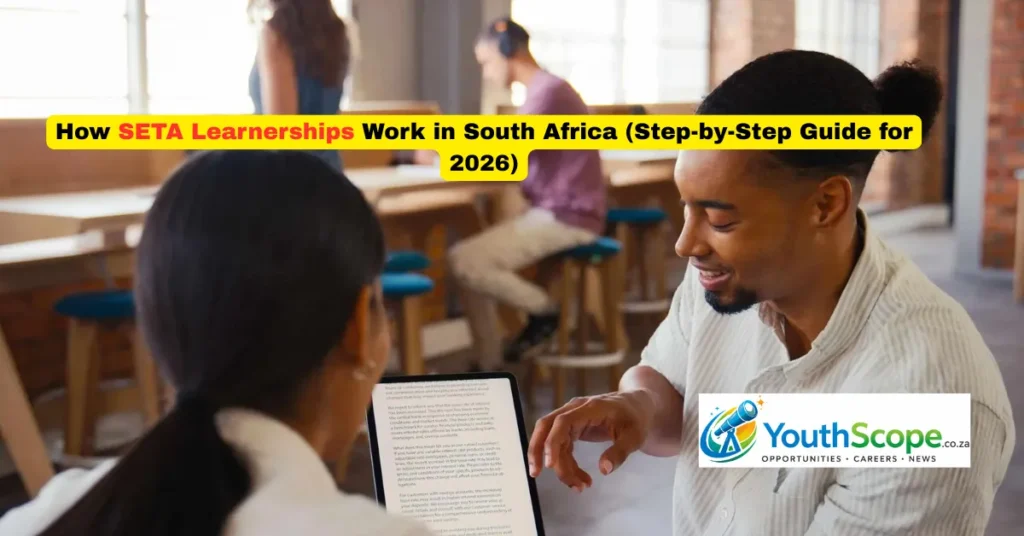
How SETA Learnerships Work in South Africa (Step-by-Step Guide for 2026)

If you’re trying to break into the job market in 2026, understanding how SETA learnerships work could seriously level up your chances.

Every year, thousands of young South Africans land their first real workplace experience through SETA-funded programmes. These aren’t random short courses — they’re structured training pathways that combine theory + real work exposure + a recognised qualification.

Here’s exactly how the system works (step by step)

The Basics: What Is a SETA Learnership?

A SETA learnership is a formal work-based learning programme supported or funded by a Sector Education and Training Authority (SETA).

It includes:

  • Structured classroom learning
  • Real workplace experience
  • Assessments and moderation
  • An NQF-registered qualification

It’s not just training — it’s a pathway into the labour market.

What Is a SETA?

SETAs (Sector Education and Training Authorities) are government-established bodies that manage skills development in different industries.

They operate under the national skills system overseen by the Department of Higher Education and Training.

Examples include:

  • Services SETA
  • MICT SETA
  • BANKSETA
  • HWSETA
  • merSETA
  • CETA

Each SETA focuses on skills shortages in its sector — from IT to construction to healthcare.

Step-by-Step: How SETA Learnerships Actually Work

Understanding the process helps you apply smarter.

Step 1: Skills Gaps Are Identified

Each year, SETAs analyse labour market data to find “scarce skills.”

These might include:

  • IT support
  • Business administration
  • Engineering trades
  • Healthcare support
  • Finance & banking
  • Construction

Learnerships are then designed around those shortages.

Step 2: Employers Partner With SETAs

Companies or training providers partner with a SETA to host learners.

The employer agrees to:

  • Provide workplace training
  • Supervise learners
  • Support assessments
  • Participate in evaluation

SETAs often help fund training costs and stipends.

Step 3: Opportunities Are Advertised

Learnerships are posted through:

  • Company career pages
  • SETA websites
  • Government portals
  • Trusted platforms

Each advert lists:

  • Minimum requirements
  • Duration
  • NQF level
  • Stipend (if included)
  • Closing date

⚠ Always apply through official channels.

Step 4: You Apply

Most programmes require:

  • SA ID
  • Matric certificate
  • Updated CV
  • Proof of residence

Some may require:

  • Medical fitness
  • Criminal clearance
  • Specific subjects (e.g., Maths, English)

This is where many applicants get filtered out — incomplete documents = instant rejection.

Step 5: Screening & Shortlisting

After the closing date, applications are reviewed.

This may include:

  • Document verification
  • Academic screening
  • Basic assessments

Popular programmes can receive thousands of applications — so accuracy matters.

Step 6: Interviews & Assessments

Shortlisted candidates may complete:

  • Interviews
  • Aptitude tests
  • Psychometric assessments
  • Medical checks

Not every programme includes all of these — but many do.

Preparation makes a big difference here.

QUICK LINKS:

Step 7: Signing the Learnership Agreement

If selected, you sign a formal agreement between:

  • The learner
  • The employer
  • The training provider
  • The SETA

This is a legal training contract, not permanent employment.

It outlines:

  • Duration
  • Responsibilities
  • Stipend terms
  • Assessment requirements

Step 8: Training Begins

Once enrolled, your learnership officially starts.

Most programmes include:

  • Classroom learning
  • Workplace practice
  • Portfolio of evidence
  • Ongoing assessments

Typical duration:

  • Most learnerships: ±12 months
  • Technical/artisan programmes: sometimes longer

You must complete both theory and practical components.

Step 9: Qualification & Completion

At the end of the programme, you’re assessed against national standards.

If successful, you receive:

  • An NQF-registered qualification
  • Recognised workplace experience
  • Improved employability

That combination is what makes learnerships powerful.

How SETA Learnerships Work in South Africa (Step-by-Step Guide for 2026)

Do SETA Learnerships Pay?

Most do — but it’s important to understand:

  • It’s a stipend, not a salary
  • Amounts vary by sector
  • Payment depends on funding structure

Typical ranges in South Africa:

  • NQF Level 2–4: ±R1,500–R4,500 per month
  • Higher-level programmes: sometimes more

The stipend helps cover transport and basic living costs.

Who Should Apply?

SETA learnerships are ideal for:

✔ Matriculants
✔ TVET graduates
✔ Unemployed youth
✔ Entry-level job seekers
✔ Career changers

Most youth-focused programmes target ages 18–35 — but always check the advert

Common Mistakes That Hurt Your Chances

Many applicants fail for avoidable reasons:

  • Applying after the deadline
  • Submitting uncertified documents
  • Ignoring subject requirements
  • Using a weak CV
  • Applying for roles they don’t qualify for
  • Only applying to one opportunity

Consistency matters more than luck.

How to Improve Your Chances in 2026

Want better results?

  • Apply early
  • Prepare certified documents in advance
  • Tailor your CV for each programme
  • Apply to multiple verified opportunities
  • Check your email daily
  • Keep your phone reachable

Persistence is key in the SETA space.

Frequently Asked Questions

Do SETA learnerships guarantee permanent jobs?
No. They are fixed-term training contracts — but they improve employability significantly.

Can I apply while studying full-time?
Most funded learnerships require you to be unemployed and not enrolled full-time.

How long do learnerships last?
Usually 12 months, sometimes longer for technical programmes.

Are qualifications recognised?
Yes. They are registered on the National Qualifications Framework (NQF).

Final Thoughts

Understanding how SETA learnerships work gives you a real advantage in 2026.

These programmes remain one of the most reliable entry points into the job market for young South Africans.

If you prepare early, follow instructions exactly, and apply consistently, your chances improve dramatically.

Stay organised. Stay alert. Apply smart.

Recent Posts

Mintek Work Integrated Learner 2026 (R100,152 CTC) – Electronics/Electrical Engineering WIL Guide

Need workplace training to finish your diploma?

The Mintek Work Integrated Learner (WIL) 2026 opportunity is a paid placement designed for Electronics and Electrical Engineering students who must complete in-service training to graduate.

This isn’t casual work. It’s structured, technical exposure inside a national research organisation — and it pays.

Let’s break down exactly who qualifies, how to apply properly, and what can get you rejected.

Quick Overview (Read This First)

  • Company: Mintek
  • Role: Work Integrated Learner (WIL)
  • Field: Electronics or Electrical Engineering
  • Study level required: S4/S5 completed
  • Salary: R100,152.00 CTC per annum (non-negotiable)
  • Location: Randburg, Johannesburg
  • Address: 200 Malibongwe Drive
  • Citizenship: South African citizens only
  • Closing date: 5 March 2026
  • Testing: Psychometric assessment required

Important: You must arrange your own accommodation and transport.

What Is Work Integrated Learning (WIL)?

Work Integrated Learning (WIL) is the practical workplace component required to complete many diplomas.

It’s where you:

  • Apply what you learned in class
  • Work in a real technical environment
  • Gain experience employers actually value

Mintek clearly states the purpose: to provide practical workplace exposure to students who need it to complete their qualifications.

This is structured learning — not just “getting experience.”

QUICK LINKS:

Who Can Apply?

Apply ONLY if you meet all these requirements:

✔ South African citizen
✔ Completed S4/S5 in Electronics Engineering or Electrical Engineering
✔ Academic average of around 60%
✔ Require in-service/WIL training to graduate

If you’re still at S1–S3 level, this opportunity is likely not for you yet.

What Mintek Is Evaluating

Mintek places learners within technical divisions. They expect:

  • Computer literacy (Word, Excel, PowerPoint)
  • Strong numerical and analytical ability
  • Good communication skills
  • Attention to detail

Translation for applicants:

You may handle technical data, documentation, testing support, and reports. Accuracy matters. Sloppy work won’t survive in a lab or engineering environment.

Required Documents (Missing These = Rejection)

Mintek specifies the following:

  • CV
  • Certified academic record
  • Certified in-service training letter from your university
  • Copy of SA ID

🚨 The in-service training letter is often the most forgotten document.

Pro Tips:

  • Combine everything into ONE clean PDF (if the system allows).
  • Make sure certifications are clear and readable.
  • Name your file professionally:
    Mintek_WIL_2026_NameSurname.pdf

Why Applicants Get Disqualified

Even strong students get screened out for these reasons:

  1. Academic average below 60%
  2. Not yet completed S4/S5
  3. Wrong qualification (not Electronics/Electrical Engineering)
  4. Missing in-service letter
  5. Not a South African citizen
  6. Incomplete documents
  7. Refusing psychometric testing
  8. Unrealistic logistics (can’t arrange accommodation/travel)

Mintek also states:
If you don’t hear back within one month after the closing date, consider your application unsuccessful.

Mintek Work Integrated Learner 2026 (R100,152 CTC) – Electronics/Electrical Engineering WIL Guide

How to Apply (The Safe Way)

Apply via the official Mintek careers portal or recognised job platforms that link back to the official listing.

Deadline: 5 March 2026

Never pay anyone to “secure” the placement. This is a legitimate structured opportunity.

📍 Location Planning – Randburg

Mintek’s offices are located at:

200 Malibongwe Drive, Randburg, Johannesburg

Before applying, ask yourself:

  • Can I afford accommodation nearby?
  • How will I travel daily?
  • Can I be punctual every day?

Technical environments value reliability.

How to Write a Strong WIL CV (Fast Checklist)

Keep it 1–2 pages max.

Include:

  • Correct contact details
  • Qualification + institution
  • Completed S4/S5 modules (list strongest 6–10)
  • Academic average (if 60%+)
  • Software/tools knowledge
  • Projects (briefly explain your role and results)
  • Mention that you require WIL/in-service training

Avoid:

  • Long paragraphs
  • Missing dates
  • No academic results mentioned
  • Forgetting the WIL requirement explanation

Engineers are evaluated on clarity and precision — your CV should reflect that.

FAQ

Is it paid?
Yes. R100,152.00 CTC per annum (non-negotiable).

Who qualifies?
South African citizens who completed S4/S5 in Electronics or Electrical Engineering and require WIL.

Will there be testing?
Yes. Psychometric testing applies.

Do I need to live near Mintek?
You must arrange your own accommodation and transport.

Closing date?
5 March 2026.

Final Note

If you meet the requirements, this is a strong stepping stone. Mintek is a recognised South African research and technology organisation with structured technical divisions — which means real exposure and credible experience on your CV.

If you qualify, apply early, submit clean documents, and treat this like a professional engineering opportunity — because that’s exactly what it is.

Recent Posts

ETDP SETA ECD Learnerships 2026 (R3,000/Month Stipend) – Your Real Guide to Getting In

Want to work with young children and actually make a difference — while earning a monthly stipend?

The ETDP SETA ECD Learnerships 2026 could be your entry point into Early Childhood Development (ECD). Some official programme documents show stipends of R3,000 per month for 12 months — meaning this is a real “earn while you learn” opportunity.

This guide breaks it down clearly: who qualifies, how to apply safely, and the real reasons people get rejected.

Quick Facts for 2026

  • Programme: ECD Learnership (Education sector)
  • Funded by: ETDP SETA
  • Stipend (example intake): R3,000/month
  • Duration: Usually 12–18 months
  • Fees:  Legit programmes do NOT charge application fees

Why ECD Is a Serious Career (Not Just Babysitting)

ECD is about early learning, child development, safety, and preparing children for school.

The Department of Basic Education (DBE) highlights that quality Early Childhood Development improves school readiness and long-term outcomes — especially in disadvantaged communities.

That’s why trained ECD practitioners are in demand. You’re shaping the foundation years (birth to five years old).

What Is an ECD Learnership?

An ECD learnership combines:

1️⃣ Structured theory training
2️⃣ Practical workplace experience at an ECD centre

If accepted, you’ll usually:

  • Sign a learnership agreement
  • Attend training sessions
  • Complete supervised workplace practice
  • Undergo assessments
  • Receive a recognised qualification

You gain experience AND a formal credential.

Who Can Apply in 2026?

Requirements vary per intake, but most funded programmes look for:

✔ South African ID
✔ Unemployed youth (often strictly required)
✔ Minimum education level (commonly Grade 11, Grade 12, or equivalent depending on intake)
✔ Not enrolled in another funded programme

⚠ Important: Some intakes exclude applicants who already hold certain ECD qualifications. Always read carefully.

QUICK LINKS:

Choose the Correct ECD Level (Or You’ll Be Rejected)

Many applicants get screened out because they apply for the wrong level.

Programmes may target:

  • Entry-level candidates (first qualification)
  • Existing ECD practitioners needing advanced training

If your education/experience doesn’t match the level advertised, your application may fail before shortlisting

Where to Apply Safely (Avoid Scams)

Stick to official and trusted platforms:

1️⃣ Department of Basic Education eCares

Referenced in the Bana Pele ECD registration drive.

2️⃣ SA Youth

Provides verified ECD learnership guidance and application pathways.

3️⃣ ETDP SETA

Publishes official programme documents and provincial intake details.

🚨 Red flag: Anyone asking for money to “secure placement.”

ETDP SETA ECD Learnerships 2026

Step-by-Step: How to Apply in 2026

Step 1: Prepare Your Documents Early

Most programmes require:

  • Certified copy of ID (recent certification)
  • Certified school results
  • Updated CV

Keep everything in one clean PDF if applying online.

Step 2: Register on the Correct Portal

Create your profile on platforms like SA Youth or the official provider portal.

Use matching details (name, ID, phone number) to avoid verification failure.

Step 3: Apply Only When Intake Is Open

Applications close quickly. Monitor official announcements regularly.

Step 4: Submit Correctly

Common mistakes:

  • Blurry document photos
  • Missing certification
  • Leaving out attachments
  • Submitting multiple applications (some intakes allow only one)

Step 5: Shortlisting & Placement

If shortlisted, you may go through:

  • Document verification
  • Training provider matching
  • Workplace placement at an ECD centre
  • Ongoing assessments

Not everyone is contacted — only shortlisted candidates.

Stipend & Duration: What to Expect

Some official programme documents show:

  • R3,000/month for 12 months (specific intake example)

But remember:

  • It’s a stipend (support allowance), not a salary
  • Amounts vary by intake and funding

Most ECD learnerships last 12–18 months.

Why Applicants Get Disqualified

This is where most people lose their chance:

  1. Not unemployed (when required)
  2. Being enrolled in another funded programme
  3. Submitting duplicate applications
  4. Missing or outdated certification
  5. Incorrect contact details
  6. Applying through scam channels
  7. Choosing the wrong qualification level

Most rejections happen during document screening — not interviews.

How to Make Your Application Stronger

Want to increase your chances?

✔ Keep your CV one page and clear
✔ Mention childcare experience (volunteering, tutoring, Sunday school, babysitting)
✔ Show reliability (attendance, responsibility)
✔ Be ready for consistent travel to the ECD centre
✔ Keep a “ready folder” with certified documents

Small improvements = higher shortlist chance.

FAQ

Is the R3,000 stipend guaranteed?
No. It depends on the specific funded intake. Always confirm in the official advert.

Are applications free?
Yes. Legitimate programmes do not charge fees.

Does completing the learnership guarantee a job?
No. It improves employability but doesn’t guarantee employment.

Biggest rejection reason?
Incomplete or uncertified documents — and not meeting unemployment requirements.

Final Advice for 2026 Applicants

Prepare early.
Apply only through official channels.
Follow instructions exactly.

When programmes fill fast and only shortlisted candidates are contacted, being correct and complete is what sets you apart.

Recent Posts

FASSET Learnership Programme 2026/2027 (R3,500–R5,100 Stipend) — Your Step-by-Step Youth Guide

Want to break into finance but don’t have experience yet? The FASSET Learnership Programme 2026/2027 could be your gateway.

If you’re serious about accounting, payroll, auditing, tax, or office admin, this is one opportunity you should understand properly — especially how to apply the right way and avoid common rejection mistakes.

Let’s break it down in simple terms

Quick Facts (Before You Apply)

  • Organisation: FASSET
  • Field: Finance & Accounting Services
  • Stipend: Around R3,500–R5,100 per month (varies by programme)
  • Who gets paid? Unemployed learners
  • How placements work: Often through employers or training providers — not always directly through FASSET

Important: Not every programme pays the exact same amount. Always check the specific advert.

What Is FASSET (And Why Should You Care?)

FASSET is the SETA responsible for skills development in South Africa’s finance and accounting sector.

That means their learnerships connect you to real career paths like:

  • Accounting technician
  • Bookkeeping & finance admin
  • Payroll & tax assistant
  • Junior audit support
  • Office administration in finance environments

The biggest win? You don’t just study — you gain workplace experience while working toward a recognised qualification.

QUICK LINKS:

Learnership vs Internship vs TVET WBE (Don’t Confuse These!)

A lot of young people get rejected because they apply for the wrong type.

1️⃣ Learnership

  • Structured training + workplace experience
  • Leads to a recognised qualification
  • Includes a monthly stipend (if unemployed)

2️⃣ TVET Work-Based Experience (WBE)

For students who finished N6 theory and need workplace exposure to graduate.

Some 2026 WBE-related intakes show stipends between R3,500–R5,100/month, but amounts vary.

3️⃣ Internship

May be workplace-only and not always qualification-linked. Always read carefully.

Who Can Apply?

Requirements differ by programme, but most look for:

✔ South African citizen
✔ Unemployed youth (commonly 16–35 years)
✔ Matric or relevant qualification
✔ Basic numeracy skills (Maths/Accounting helps)
✔ Interest in finance

⚠ Important: FASSET does not automatically place every applicant. Employers and providers usually advertise available positions.

How Much Is the Stipend in 2026/2027?

Here’s the honest answer:

  • It’s an allowance, not a salary
  • Some 2026 listings show R3,500–R5,100 per month
  • The amount depends on:
    • Programme type
    • NQF level
    • Employer funding structure

Pro tip: Say “R3,500–R5,100/month (varies by programme)” — don’t assume it’s fixed.

FASSET Learnership Programme 2026/2027

How to Apply (The Safe Way)

Step 1: Understand How Recruitment Works

Start on the official FASSET website to learn how placements happen.

Step 2: Apply Through the Official Advert

Apply via:

  • Employer adverts
  • Training provider listings
  • TVET WBE intake posts

🚫 Real programmes do NOT charge application fees.
🚫 Avoid “DM to apply” social media scams.

Step 3: Prepare Your Documents

Have these ready:

  • Certified SA ID
  • Updated CV
  • Certified Matric certificate
  • Academic transcripts (if applicable)
  • WBE letter from college (for N6 applicants)

Step 4: Apply Early

Late submissions = automatic rejection.

Why People Get Disqualified

Here’s where most applicants go wrong:

  1. Applying for the wrong stream (e.g., WBE without N6 proof)
  2. Missing required subjects or qualifications
  3. Uncertified or blurry documents
  4. Wrong contact details
  5. Duplicate or inconsistent information
  6. Missing the closing date

Many rejections happen during screening — before interviews even start.

How to Make Your Application Stronger

Want to stand out?

✔ Put finance-related subjects at the top of your CV
✔ Add a short “Why Finance?” paragraph (2–3 lines)
✔ Mention Excel or computer skills
✔ Include leadership or admin experience (even school roles count)

Small improvements = big difference.

FAQ

Do FASSET learnerships pay?
Yes. Unemployed learners receive a monthly allowance.

How much in 2026?
Some public intakes show R3,500–R5,100/month — but it depends on the programme.

Can I apply without Matric?
It depends on the stream. Many finance pathways prefer Matric, especially with Maths or Accounting.

Biggest rejection reason?
Incomplete documents and applying for the wrong programme type.

Recent Posts

How to Choose the Right SETA Learnership for Your Career Path in 2026 step-by-step guide

Are you a young South African looking to gain practical skills, workplace experience, and a nationally recognised qualification? SETA learnerships are an excellent way to do this, but with so many options available, choosing the right one can feel overwhelming.

Here’s a step-by-step guide to help you identify the best learnership for your career goals in 2026.

Step 1: Understand What a SETA Learnership Is

learnership is a structured programme combining:

  • Classroom learning (theoretical knowledge)
  • Workplace experience (practical exposure)
  • A nationally recognised qualification

Learnerships are registered with Sector Education and Training Authorities (SETAs), which means your qualification is recognised across South Africa and can help you access future career opportunities.

Step 2: Identify Your Career Interests

Ask yourself:

  • What industries excite me? (e.g., finance, IT, healthcare, engineering)
  • Which roles do I see myself in long-term?
  • What skills do I want to develop in the next 12 months?

Matching a learnership to your interests ensures you stay motivated and gain relevant skills for your career path.

Step 3: Check Eligibility Requirements

Each SETA learnership has specific eligibility criteria, such as:

  • Minimum education level (Grade 12, diploma, or degree)
  • Age limits
  • Relevant subjects or prior experience

Make sure you meet these requirements before applying — otherwise, your application may be rejected.

Step 4: Research the SETA and Industry

  • Look at the SETA’s accredited learnership programmes. Each SETA focuses on a particular sector, for example:
    • CETA – chemical, energy, and related industries
    • W&RSETA – wholesale and retail
    • CHETA – hospitality and tourism
  • Check employer partnerships – some learnerships are run in collaboration with top companies, which can improve your chances of permanent employment.

Step 5: Consider the Type of Learnership

Learnerships vary in focus:

  • Technical & vocational – e.g., engineering, IT, laboratory work
  • Business & administration – e.g., finance, HR, office administration
  • Healthcare & social services – e.g., nursing, social work support
  • Entrepreneurship – e.g., business management or SMME development

Choose one that aligns with your long-term career ambitions.

Step 6: Evaluate Benefits and Growth Opportunities

A good learnership should provide:

  • Hands-on workplace experience
  • Mentorship from experienced professionals
  • Opportunities for permanent employment after completion
  • Exposure to real industry challenges and workflows

Also, consider if the learnership offers a stipend — this can be important if you need financial support during your training.

Step 7: Apply Early and Prepare Your Documents

  • CV / Résumé highlighting education and any experience
  • Certified copies of your ID and qualifications
  • Motivation or cover letter (if required)

Some learnerships have limited spots and are competitive, so early applications increase your chances of success.

Step 8: Leverage Multiple Platforms

You can find learnerships through:

  • SETA websites (each SETA publishes its learnerships)
  • SAYouth.mobi – free access to youth opportunities
  • Impactful.co.za – accredited learnership and skills programmes
  • Employer portals – some companies advertise their learnerships directly

Make a list of suitable opportunities and track your applications carefully.

How to Choose the Right SETA Learnership for Your Career Path in 2026 step-by-step guide

Final Tip: Align Your Learnership With Your Career Vision

Ultimately, the right learnership is one that matches your interests, develops your skills, and opens doors to your future career. Take time to research, evaluate, and apply strategically — your learnership in 2026 could be the stepping stone to your dream job.

Recent Posts