
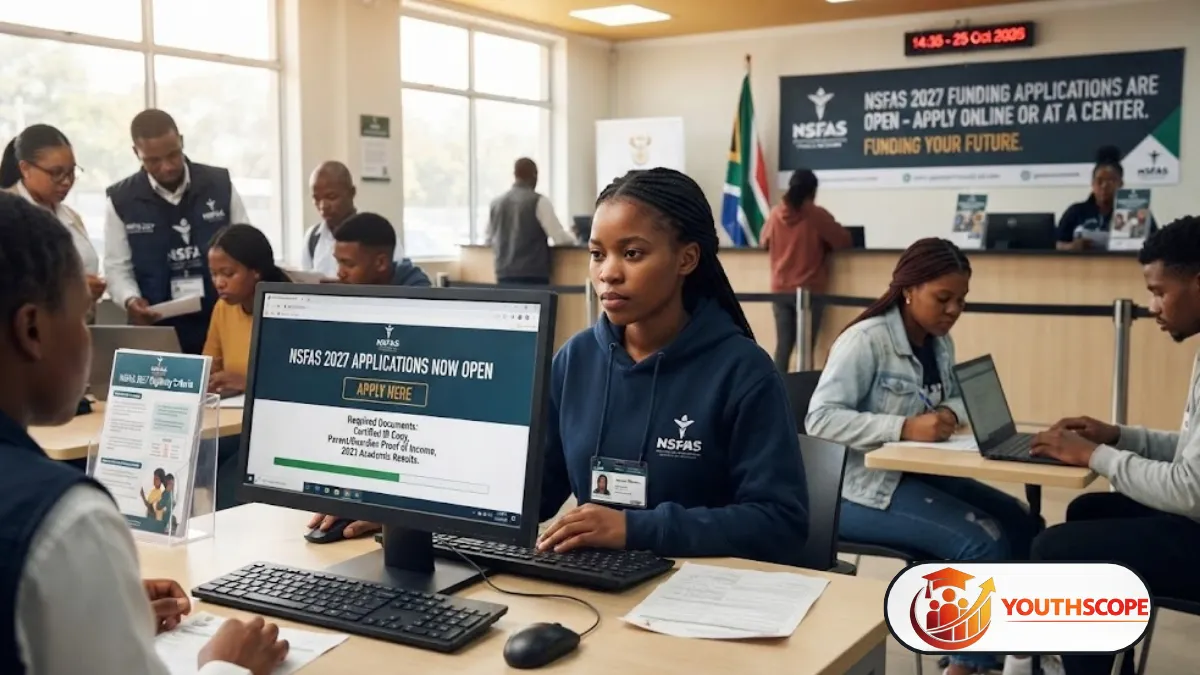
The NSFAS 2027 application period is open, and students have until 31 October 2026 to submit applications for funding for the 2027 academic year.
The National Student Financial Aid Scheme says applications opened on 18 September 2026 and will close on 31 October 2026. Applying is free, and the application can be completed online using a cellphone, computer or other internet-connected device.
Students do not need to wait for the final days of October. NSFAS specifically advises applicants to apply early, prepare their documents and check their information carefully before submitting.
NSFAS’s official application system also allows applicants to track their application status through myNSFAS after submission.
Quick Summary
| Detail | NSFAS 2027 information |
|---|---|
| Funding year | 2027 |
| Applications opened | 18 September 2026 |
| Closing date | 31 October 2026 |
| Application fee | Free |
| Application method | Online |
| Cellphone application | Yes |
| Status tracking | myNSFAS |
| Public institutions covered | Public universities and TVET colleges, subject to NSFAS rules |
| Application portal | Official NSFAS/myNSFAS channels |
| Late applications | NSFAS says late applications cannot be accepted |
NSFAS 2027 Applications Are Open
NSFAS has officially opened applications for the 2027 academic year.
The application window runs from 18 September 2026 until 31 October 2026. NSFAS says the system will close at the end of the closing date and that late applications cannot be accepted.
This means students who intend to seek NSFAS funding for 2027 should complete their applications before the deadline rather than waiting until the final day.
The application itself is free.
NSFAS 2027 Closing Date
31 October 2026
This is the key date applicants need to remember.
NSFAS currently states that applications close on 31 October 2026, and its official application page says late applications cannot be accepted.
Applicants should therefore allow enough time to:
- Create or access their myNSFAS account.
- Complete their personal information.
- Provide household information.
- Complete the required consent process.
- Upload supporting documents.
- Review the application.
- Submit it.
- Save the application reference number.
Who Can Apply for NSFAS 2027?
NSFAS states that South African citizens and permanent residents who plan to study, or are already studying, at a public university or TVET college can apply, subject to the applicable funding requirements.
Financial eligibility differs according to the applicant category.
For the NSFAS bursary:
- Verified SASSA grant recipients automatically meet the financial requirement.
- Non-SASSA applicants generally need gross combined household income of R350,000 or less per year.
- Applicants with disabilities generally have an income threshold of R600,000 or less per year.
NSFAS also has a student-loan funding category with different income thresholds. Students should check the current NSFAS eligibility rules rather than assuming that the bursary and loan requirements are identical.
Important
Meeting the income threshold does not automatically guarantee funding.
Applicants must also meet the other applicable requirements and successfully complete the verification and assessment process.
Can Grade 12 Learners Apply Before Getting Their Final Results?
Yes.
NSFAS’s 2027 application information says learners who are still in Grade 12 can apply while they are writing matric. Their results are confirmed later.
NSFAS also says applicants can apply before they have been accepted at an institution.
This is particularly important for current Grade 12 learners planning their 2027 studies.
Documents Needed for NSFAS 2027
Applicants should prepare clear copies of the documents applicable to their circumstances.
NSFAS’s current 2027 supporting-document information identifies the following:
For applicants
A copy of:
- South African ID or birth certificate
- Smart ID card, where applicable, with both sides visible
Parent, guardian or spouse information
Depending on the applicant’s circumstances, NSFAS may require:
- ID copies of parents or legal guardian
- Income evidence
- Signed consent documentation
NSFAS says income evidence can include payslips for the last three months, a UIF statement or an affidavit where income is informal, depending on the circumstances.
If a parent or guardian has died
A death certificate may be required for each deceased parent or guardian.
If parents are divorced or separated
NSFAS may require a divorce decree or settlement agreement showing maintenance arrangements.
If you have a legal guardian
Proof of legal guardianship issued by a court may be required.
If you are married
NSFAS lists a marriage certificate and the spouse’s ID among documents that may apply in this circumstance.
Consent form
The 2027 NSFAS Consent Form is required for applicants and gives NSFAS permission to verify information with third-party sources.
The form must be completed and signed correctly. NSFAS says an incomplete or unsigned consent form can prevent an application from being assessed for financial eligibility.
Important document rule
Do not upload every possible document simply because it appears on a general checklist.
NSFAS says the system generates a document list based on the applicant’s circumstances, so applicants should check myNSFAS to see exactly what has been requested.
How to Apply for NSFAS 2027 Using a Cellphone
You do not need a computer to submit the application.
NSFAS says the 2027 application process works on a small screen and can be completed through a cellphone browser. Documents can also be photographed with a phone and uploaded directly.
Step 1: Create or access myNSFAS
Register using:
- Your South African ID number
- Your cellphone number
- An email address you can access
If you already have a myNSFAS account, NSFAS says you should not create a second account. Sign in to your existing account instead.
Step 2: Complete your personal information
Enter your information carefully.
NSFAS says details such as your name, date of birth and address should match your ID information.
Step 3: Provide household information
You will need to provide information about your household and the income that applies to your circumstances.
Step 4: Complete the consent requirements
NSFAS uses consent to verify information with sources including Home Affairs, SARS and SASSA.
Step 5: Upload your documents
Use your phone camera to photograph documents if necessary.
Make sure the entire document is visible and that the text is readable.
NSFAS specifically says clear phone photographs are acceptable as long as every corner is visible and the text can be read.
Step 6: Review everything
Before submitting, check:
- Name spelling
- ID number
- Date of birth
- Contact details
- Household information
- Institution information
- Uploaded documents
- Consent information
Step 7: Submit
Once submitted, NSFAS says the application is locked for assessment.
Applicants receive confirmation on screen and by SMS.
Step 8: Save your reference number
Keep your NSFAS application reference number somewhere safe.
You will need it when checking the progress of your application or communicating with NSFAS.
How to Check Your NSFAS 2027 Application Status
After submitting your application, you can track it through myNSFAS.
NSFAS says applicants should sign in to see which stage their application has reached and whether anything is required from them.
The application journey can include stages such as:
- Apply
- Verification
- Documents
- Eligibility
- Registration
- Funding
- Allowances
- Support or appeals
“Verification in progress”
This means NSFAS is confirming information with sources such as Home Affairs, SARS and SASSA.
According to NSFAS, applicants do not need to take action while this verification is taking place unless the system asks for something else.
“Awaiting documents”
This indicates that NSFAS needs a document or that something submitted may be missing or unreadable.
Applicants should sign into myNSFAS and upload what has been requested.
“Funding eligible”
This indicates that the applicant meets the funding criteria at that stage. NSFAS says funding is confirmed once the student registers at a public university or TVET college.
“Unsuccessful”
An unsuccessful outcome means the application did not meet the applicable criteria.
The reason should be available through myNSFAS, and eligible applicants may have an opportunity to appeal within the applicable appeal period.
Common NSFAS Application Mistakes
1. Creating a second account
If you already have a myNSFAS account, do not create another one.
NSFAS specifically warns applicants to use their existing account.
2. Entering information that does not match your ID
Check your name, date of birth and other personal details carefully.
NSFAS says personal information should match the applicant’s ID information.
3. Uploading unreadable documents
A blurry photograph can create problems during document verification.
Take photographs in good lighting and make sure every corner of the document is visible.
4. Forgetting the consent form
NSFAS requires consent to verify relevant information.
An incomplete, inaccurate or unsigned consent form can prevent the financial assessment from proceeding.
5. Using someone else’s cellphone number
NSFAS advises applicants to use their own cellphone number.
Important notices can be sent to the number linked to the account.
6. Forgetting your reference number
Save the reference number immediately after submitting.
It is an important record of your application.
7. Paying someone to apply
Do not pay anyone to submit or speed up a NSFAS application.
NSFAS states that applying is free and warns that anyone charging applicants to apply or speed up an application is committing fraud.
8. Sharing your password or OTP
NSFAS says applicants should never share their password or one-time PIN, including with someone who claims to be helping with the application.
What Happens After Applying?
Submitting your application does not mean funding has already been approved.
NSFAS first processes and verifies the application.
According to the official application journey, the process can move through:
Application → Verification → Documents → Eligibility → Registration → Funding → Allowances → Support/appeals.
Applicants should therefore keep checking their myNSFAS account rather than assuming that a submitted application means everything is complete.
Keep checking for missing documents
NSFAS says applicants should monitor their accounts for requests for additional supporting documents.
The current supporting-document information states that applicants have 30 working days to submit requested missing documents.
What happens after funding eligibility?
NSFAS explains that funding is confirmed once an eligible student registers at a public university or TVET college.
Funding can include tuition and registration, approved accommodation or transport support, learning materials and a personal care allowance, depending on the applicable NSFAS funding policy and the student’s circumstances.
What Students Should Do Now
With the 31 October 2026 deadline approaching, applicants should focus on completing the process rather than waiting for the final days.
If you have not started
Create your myNSFAS account and begin the application.
If you started but have not submitted
Complete the remaining sections, upload the required documents and submit.
If you have submitted
Save your reference number and regularly check myNSFAS for updates or document requests.
If NSFAS asks for more documents
Upload the requested documents as soon as possible and check that they are clear and readable.
NSFAS 2027 Deadline
31 October 2026
NSFAS currently states that the 2027 application window closes on 31 October 2026 and that late applications cannot be accepted.
Students should not wait until the final hours if they can complete the application earlier.
Suggested:
- UNISA 2027 application status
- TVET college opportunities
- Bursaries and funding opportunities
- NSFAS application status
- NSFAS-Funded Cyber Security Programme 2026
- 2027 study opportunities
Frequently Asked Questions
When do NSFAS 2027 applications close?
The official closing date is 31 October 2026.
Is it free to apply for NSFAS?
Yes. NSFAS states that applying is free. Anyone asking for money to submit or speed up an application should be treated with caution.
Can I apply using my cellphone?
Yes. NSFAS says the 2027 application can be completed online using a cellphone, and documents can be photographed and uploaded from the phone.
Can Grade 12 learners apply before receiving their final results?
Yes. NSFAS says current Grade 12 learners can apply while they are still writing matric, with results confirmed later.
What documents do I need?
At minimum, NSFAS identifies an ID or birth certificate, relevant parent/guardian information and a signed consent form. Additional documents depend on the applicant’s circumstances.
How do I check my NSFAS application status?
Sign into your myNSFAS account and use the application-status information. NSFAS says applicants can track their application at any time.
What if I forgot my myNSFAS password?
Use the Forgot password option on the sign-in page. NSFAS says a reset link or OTP is sent to the cellphone number and email address associated with the account.
Can someone apply for me?
Someone may help you, but NSFAS says the account must belong to you and applicants should never give another person their password or OTP.
What if my NSFAS application is unsuccessful?
Eligible applicants may appeal within the applicable appeal period. NSFAS’s appeal information states that students generally have 30 days after receiving their application results to appeal.
Can I apply after 31 October?
NSFAS currently states that late 2027 applications cannot be accepted.
Official Source
National Student Financial Aid Scheme (NSFAS)
The official NSFAS 2027 application information confirms that applications opened on 18 September 2026 and close on 31 October 2026. It also provides the application process, document guidance, eligibility information, cellphone instructions and application-status tracking.
Last Checked Date
1 October 2026
Author/Updated Information
Written by: Mbalizuke Nkosi
Published: 1 October 2026
Updated: 1 October 2026
Information checked: 1 October 2026

Mbalizuke Nkosi is the editorial voice behind YouthScope.co.za, a South African youth-focused platform dedicated to providing reliable information on opportunities, education, and career development. The platform serves students, graduates, job seekers, and young professionals by delivering accurate, timely, and easy-to-understand content.
Through informative and professionally curated content, YouthScope.co.za aims to equip young people with the knowledge and resources needed to make informed decisions about their education and future careers.
For inquiries or support, please contact admin@youthscope.co.za.