
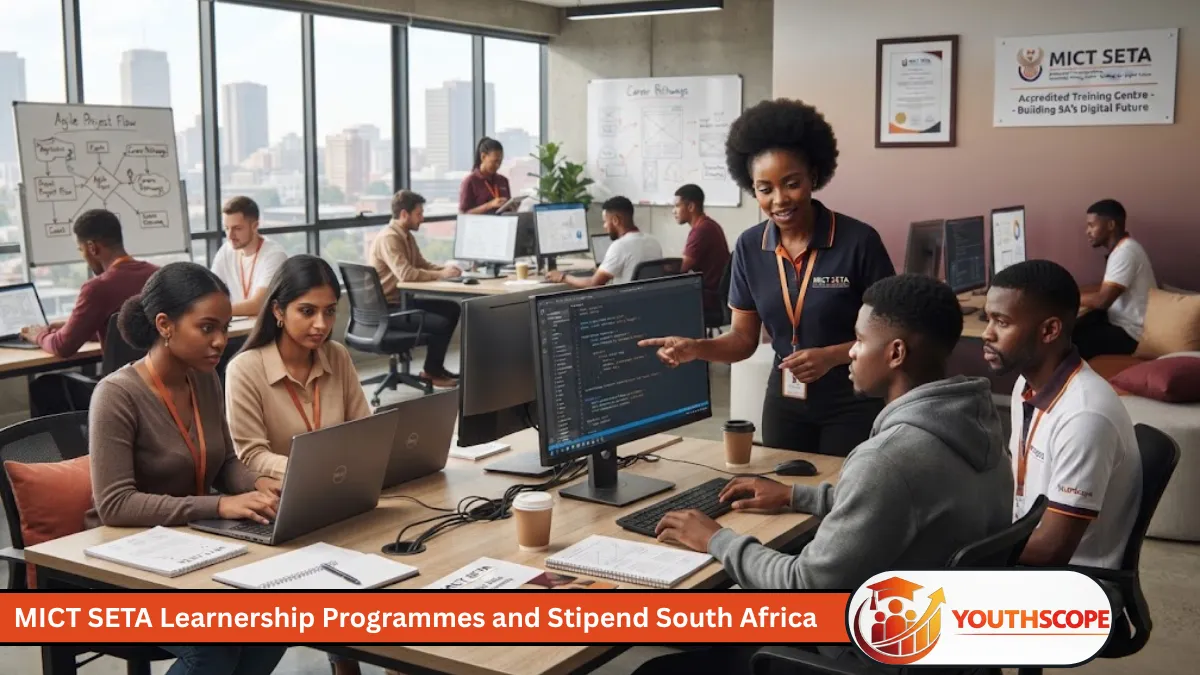
South African youth, unemployed jobseekers and aspiring technology and media professionals can explore MICT SETA learnership programmes as a route to occupational skills, workplace experience and recognised qualifications.
The Media, Information and Communication Technologies Sector Education and Training Authority (MICT SETA) supports skills development across South Africa’s media, information and communication technology sectors. Its learnership model combines theoretical learning with practical workplace experience and can lead to occupational qualifications registered on the National Qualifications Framework (NQF).
Importantly, MICT SETA states that learners participating in its funded learnership programmes may qualify for a R2,500 monthly stipend, subject to successful attendance and fulfilment of programme requirements.
Employer / Organisation
Organisation: MICT SETA
Programme: MICT SETA Learnership Programmes
Sector: Media, Information and Communication Technologies
Location: South Africa; location depends on the specific programme
Programme Duration: Depends on the individual learnership
Employment Type: Learnership / Work-based education and training
Qualification Levels: Current occupational examples include NQF Level 5 and NQF Level 6
Stipend: R2,500 per month for eligible learners on MICT SETA-funded learnership programmes, subject to applicable requirements
Closing Date: Not specified. Early applications are encouraged.
What Is an MICT SETA Learnership?
A learnership is a work-based education and training programme linked to a qualification registered on the NQF.
MICT SETA’s learnership model combines structured theoretical learning with practical workplace experience. This means participants do not simply study theory; they also receive an opportunity to apply their knowledge in a workplace environment.
A typical learnership involves three key parties:
- The learner
- The training provider
- The employer
The training provider delivers the learning component, while the employer provides the relevant workplace environment and practical exposure. MICT SETA supports the broader implementation of funded learning programmes.
MICT SETA Learnerships in Technology and Media
MICT SETA’s occupational programmes cover a range of careers within the technology, media and communications sectors.
Examples of registered occupational qualifications include:
- Software Engineering
- Software Testing
- Computer Technology
- ICT Business Development
- Advertising
- Sound Operation
- Media and Programme Content Production Management
The qualifications highlighted in the available information range from NQF Level 5 to NQF Level 6.
This means MICT SETA opportunities are not restricted to traditional IT support roles. Depending on the programme available, learners can explore technology, software, media, advertising, sound and business-development career pathways.
Software Engineer Learnership
The Occupational Certificate: Software Engineer is registered at NQF Level 6.
Software engineering involves designing, developing, testing and maintaining software systems. A learnership linked to this qualification may be relevant to people interested in programming, software development and digital technologies.
Applicants should check the individual programme advertisement for the exact entry requirements because the existence of a registered qualification does not mean that applications for that qualification are always open.
Software Tester Learnership
The Occupational Certificate: Software Tester is registered at NQF Level 5.
Software testers help assess applications and systems to identify problems and ensure that software performs as expected.
This pathway may appeal to learners interested in technology, quality assurance and software development.
Computer Technician Learnership
The Occupational Certificate: Computer Technician is registered at NQF Level 5.
Computer technicians can work with computer hardware, software installation, troubleshooting and technical support.
For people interested in IT support and technical services, this type of occupational qualification can provide a structured route into the technology sector.
Other MICT SETA Occupational Learnerships
MICT SETA’s occupational qualification offerings also include areas such as:
- Advertising
- Sound operation
- ICT business development
- Media and programme content production management
These programmes demonstrate the breadth of the MICT sector, which covers more than software and computer technology.
Depending on available funded projects, applicants may find opportunities across:
- Information technology
- Software development
- Digital services
- Advertising
- Media production
- Sound and broadcasting
- Business development
- Content production
Programme availability depends on the projects, employers and training providers implementing the learnership.
MICT SETA Learnership Stipend
One of the most important considerations for prospective learners is whether MICT SETA-funded learnerships provide financial support.
According to the MICT SETA stipend information provided in the source material, eligible learners participating in MICT SETA-funded learnership programmes can receive a stipend of R2,500 per month.
However, payment is subject to the applicable terms and conditions.
MICT SETA states that stipends are disbursed to learners who have successfully attended the learnership programme and fulfilled the relevant programme requirements.
Is the R2,500 Stipend a Salary?
No.
The R2,500 payment is described as a learner-support grant rather than a normal employment salary.
Learners should therefore not interpret the stipend as a guarantee of permanent employment or as the same thing as a conventional monthly salary.
The purpose of the stipend is to provide financial support while eligible learners participate in their education and training.
What Happens If a Stipend Is Not Paid?
MICT SETA has also highlighted the importance of timely stipend payments through its Zero Tolerance for Unpaid Stipends position.
Learners should retain documentation relating to their learnership, including relevant agreements, attendance records and programme communications.
If an issue arises, learners should follow the appropriate official process provided by the relevant implementing organisation and MICT SETA.
Who Recruits MICT SETA Learners?
A key point for applicants is that MICT SETA does not necessarily recruit every learner directly.
Recruitment for specific learnerships can be handled by the relevant:
- Employer
- Service provider
- Training provider
MICT SETA facilitates and supports funded learning programmes, while implementing organisations may advertise vacancies and select learners.
For this reason, applicants should always identify who is actually recruiting for the specific learnership before submitting personal information.
Who Can Benefit From MICT SETA Learnerships?
Depending on the specific programme, opportunities may be relevant to:
- South African youth
- Unemployed jobseekers
- People interested in technology careers
- Aspiring software developers
- People interested in software testing
- Aspiring computer technicians
- People interested in media and advertising
- Individuals seeking occupational qualifications
- Candidates looking for practical workplace experience
Important: There is no single eligibility requirement for every MICT SETA learnership. Applicants must follow the requirements published for the particular programme.
Requirements
Requirements vary according to the learnership and implementing organisation.
Applicants should check the specific advertisement for details such as:
- South African citizenship or residency requirements, where applicable
- Required educational level
- Required qualification, if any
- Age requirements, if stated
- Employment status requirements
- Relevant technical or career interests
- Availability for the programme
- Any employer-specific requirements
Do not assume that every MICT SETA learnership requires Grade 12, a particular age range or previous work experience.
Salary / Stipend
Stipend: R2,500 per month for eligible learners participating in MICT SETA-funded learnership programmes, subject to programme requirements.
The stipend is not a salary and is dependent on the applicable terms and conditions, including successful attendance and fulfilment of programme requirements.
Documents Needed
The exact documents depend on the individual learnership. Applicants should be prepared to provide documents such as:
- Updated CV
- Copy of South African ID
- Certified qualifications where required
- Academic record where required
- Proof of residence where requested
- Any additional documents specified by the employer or training provider
Do not send sensitive personal documents to unofficial recruiters or individuals who cannot verify the legitimacy of the opportunity.
How to Apply for MICT SETA Learnerships
There is no single application process that applies to every MICT SETA learnership.
- Visit the official MICT SETA website.
- Check the learnership and learning-programme information.
- Look for current opportunities advertised by participating employers and training providers.
- Read the eligibility requirements carefully.
- Prepare your CV and supporting documents.
- Use only the application method specified in the official advertisement.
- Check the employer or training provider responsible for recruitment.
- Submit your application before the stated deadline, if one is provided.
- Keep proof of your application for your records.
- Never pay anyone who promises to guarantee a learnership placement.
MICT SETA Learnerships and the Digital Economy
The MICT sector is becoming increasingly important as South Africa’s economy continues to adopt digital technologies.
Businesses require skills in areas such as software development, IT support, digital media, communications, advertising and technology services.
MICT SETA’s occupational qualifications reflect several of these areas and can give learners an opportunity to develop skills that are relevant to technology and media-related careers.
However, completing a learnership does not guarantee permanent employment. Learners should use the programme to build skills, workplace experience, professional networks and a stronger CV.
Learnerships vs Internships
Learnerships and internships are not the same.
A learnership combines theoretical learning and practical workplace experience and is linked to a registered qualification.
An internship generally provides structured workplace exposure and training, often for graduates who already hold a university or TVET qualification.
The right option depends on your current education, qualifications and career goals.
MICT SETA Learnerships: Key Information
| Feature | Details |
|---|---|
| Organisation | MICT SETA |
| Programme type | Learnership / work-based education and training |
| Sector | Media, Information and Communication Technologies |
| Qualification | Occupational qualification registered on the NQF |
| Example qualification levels | NQF Level 5–6 |
| Example fields | Software, IT, media, advertising, sound and ICT business development |
| Stipend | R2,500 per month for eligible learners on funded programmes |
| Stipend conditions | Subject to attendance and programme requirements |
| Salary | Not a salary |
| Duration | Depends on the specific programme |
| Location | Depends on the implementing organisation |
| Closing date | Depends on the specific opportunity |
Official Application Link
MICT SETA Official Learnerships Page
MICT SETA Official Stipend Information
Applicants should use official MICT SETA information to verify current programmes, requirements and recruitment arrangements.
Expert Guidance
Career expert YouthScope Editorial Team advises applicants to prepare all required documents before applying. Ensure your CV is updated, your qualifications are certified where required, and submit your application well before the closing date to avoid technical issues. Always apply only through the employer’s official recruitment website and keep a copy of your confirmation for your records.
For MICT SETA opportunities, applicants should pay particular attention to who is recruiting the learners. MICT SETA supports funded learning programmes, but a specific opportunity may be administered by an employer, service provider or training provider.
Frequently Asked Questions
1. What is MICT SETA?
MICT SETA is the Sector Education and Training Authority responsible for supporting skills development in South Africa’s media, information and communication technologies sector.
2. How much is the MICT SETA learnership stipend?
Eligible learners participating in MICT SETA-funded learnership programmes can receive a R2,500 monthly stipend, subject to the applicable requirements.
3. Is the R2,500 MICT SETA payment a salary?
No. MICT SETA describes the payment as a learner-support grant rather than a salary.
4. What qualifications are available through MICT SETA learnerships?
Examples include occupational qualifications in software engineering, software testing, computer technology, advertising, sound operation, ICT business development and media/programme content production management.
5. What NQF levels are covered?
The occupational qualifications highlighted in the available information include NQF Level 5 and NQF Level 6 qualifications.
6. Does MICT SETA recruit learners directly?
Not necessarily. Recruitment for individual programmes may be handled by participating employers, service providers or training providers.
7. Can unemployed youth apply?
Some MICT SETA-funded programmes target unemployed learners, but eligibility varies. Applicants must check the requirements of the specific opportunity.
8. When do MICT SETA learnership applications close?
There is no single closing date for all MICT SETA learnerships. Each opportunity can have its own application period and deadline.
Final Thoughts
MICT SETA learnerships can provide South Africans with a pathway towards occupational qualifications, practical workplace experience and industry-relevant skills.
The available occupational pathways include areas such as software engineering, software testing, computer technology, advertising, sound operation, ICT business development and media production management.
For eligible learners participating in MICT SETA-funded learnership programmes, the stipend information provided states that learners can receive R2,500 per month, provided they meet the applicable attendance and programme requirements. The payment is a learner-support grant and not a salary.
Applicants should remember that MICT SETA does not necessarily recruit learners directly for every programme. Specific opportunities can be implemented through employers, service providers and training providers.
For that reason, always verify the recruiter, requirements, stipend conditions, location and closing date through official channels before submitting an application.
Disclaimer
Youthscope shares employment, internship, bursary and learnership opportunities from official employers and organisations to help South Africans access career opportunities. We are not the recruiting organisation and do not charge any application fees. Always verify information on the relevant official website before submitting your application.
Opportunity Verification
✅ Published by: YouthScope Editorial Team
✅ Last Updated: 27 August 2026
✅ Information Source: Official MICT SETA programme and stipend information
✅ Status: Reviewed for accuracy
YouthScope shares career information to help South Africans discover opportunities. Applicants should confirm final programme details with MICT SETA or the relevant implementing organisation before applying.
Related Opportunities
- CETA Learner Portal 2026: Could Registration Lead to Training Opportunities?
- EWSETA Plumbing ARPL 2026: Free Artisan Recognition for Plumbers
- MICT SETA Learnerships Pay R2,500 Monthly: Explore NQF Training and Tech Careers in South Africa
- SETA Guide 2026: Find the Right Authority for Your Career Before Applying for Learnerships
- SETA Accreditation 2026: 7 Checks South African Applicants Should Make Before Paying for Training

The YouthScope Editorial Team publishes verified South African learnerships, internships, bursaries, graduate programmes, and career opportunities. Our team researches opportunities from official employers, government departments, SETAs, universities, and trusted organisations to provide accurate career information for South African youth.