
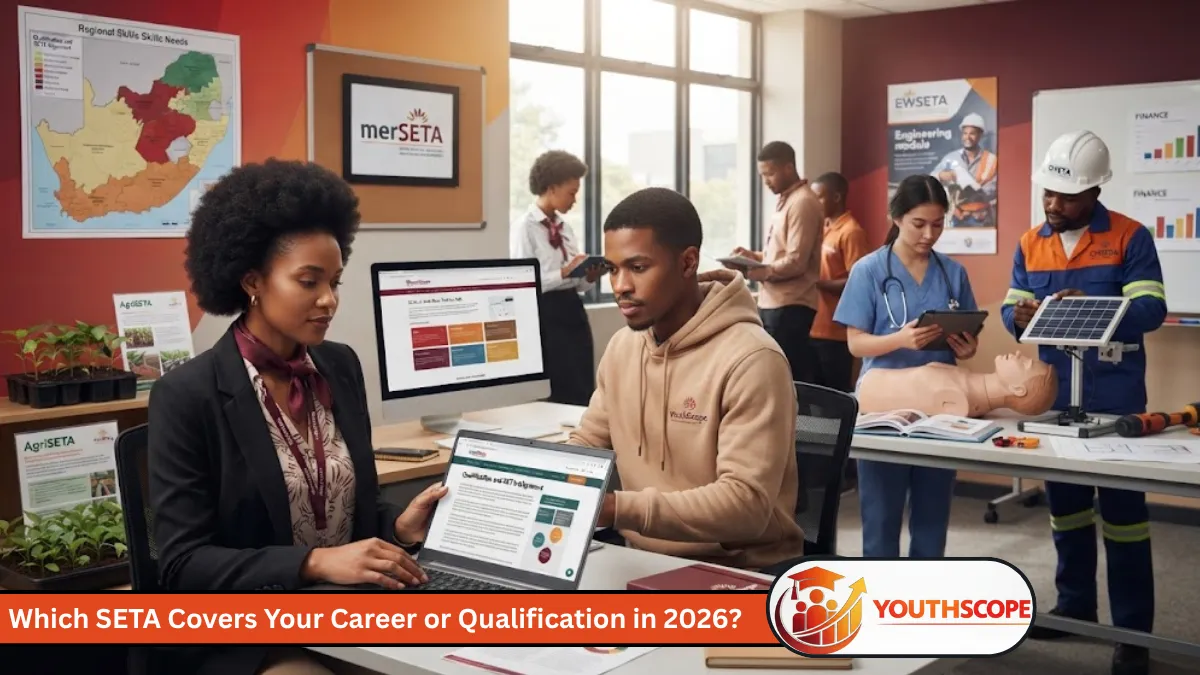
South Africa has 21 Sector Education and Training Authorities (SETAs), each responsible for skills development within a particular economic sector.
Finding the right SETA can help students, graduates, employees and unemployed South Africans identify relevant learnerships, internships, apprenticeships, bursaries and workplace training opportunities.
However, your SETA is not always determined by your job title or qualification alone. The industry of your employer, training provider, qualification and workplace can affect which SETA is relevant.
For example, an accountant working for an accounting practice may be linked to FASSET, while an accountant employed by a bank may fall under BANKSETA. An accountant working for a municipality could instead be connected to LGSETA.
This 2026 guide provides a practical starting point for identifying the SETA most likely to cover common qualifications and careers.
Why Does One Career Not Always Belong to One SETA?
SETAs are organised around economic sectors rather than occupations alone.
This means the same qualification can potentially be linked to different SETAs depending on where the person works or completes workplace training.
Consider an accounting graduate:
- Accounting practice → FASSET
- Bank → BANKSETA
- Municipality → LGSETA
- National government department → PSETA
The same principle can apply to information technology, engineering, human resources, administration, finance and project management.
Therefore, treat the matches in this guide as a starting point, not an automatic confirmation.
The final SETA may depend on the employer’s registered sector, training provider and specific funding programme.
SETA Career and Qualification Guide 2026
Agriculture, Mining and Manufacturing
These SETAs cover sectors involved in agriculture, mining, manufacturing, processing and related production activities.
AgriSETA
Agriculture Sector Education and Training Authority
AgriSETA supports skills development within the agricultural sector.
Common fields include:
- Crop and plant production
- Animal production
- Farm management
- Horticulture
- Poultry production
- Agricultural extension
- Agricultural supervision
- Agricultural entrepreneurship
- Irrigation and farm operations
Agricultural engineering can overlap with merSETA, while agricultural processing may fall under FoodBev SETA depending on the employer and activity.
Mining Qualifications Authority (MQA)
The Mining Qualifications Authority supports skills development in the mining and minerals sector.
Relevant fields include:
- Mining engineering
- Mine surveying
- Geology
- Mineral processing
- Rock engineering
- Blasting operations
- Mining supervision
- Occupational safety in mining
- Mine machinery
- Artisan trades
- Metallurgy
An artisan employed by a mining company may fall under MQA even where the same trade can appear in another industrial sector.
merSETA
The Manufacturing, Engineering and Related Services Sector Education and Training Authority supports manufacturing, engineering, automotive, metals, plastics and related industries.
Typical fields include:
- Fitting and turning
- Welding
- Boilermaking
- Mechanical engineering
- Electrical engineering in manufacturing
- Motor mechanics
- Automotive manufacturing
- Diesel mechanics
- Toolmaking
- Mechatronics
- Millwright
- Plastics manufacturing
- Tyre manufacturing
merSETA is particularly relevant when exploring artisan training, apprenticeships and engineering-related workplace programmes.
However, electrical qualifications can fall under EWSETA when the work is in the energy or water sector.
CHIETA
The Chemical Industries Education and Training Authority (CHIETA) supports the chemical manufacturing and processing sector.
Relevant areas include:
- Chemical engineering
- Analytical chemistry
- Laboratory analysis
- Process plant operations
- Pharmaceutical manufacturing
- Petroleum processing
- Fertiliser production
- Glass manufacturing
- Chemical production technology
A pharmacist working in a healthcare environment may instead connect with HWSETA, while pharmaceutical manufacturing can fall under CHIETA.
FoodBev SETA
The Food and Beverages Manufacturing Sector Education and Training Authority focuses on industrial food and beverage production.
Common fields include:
- Food technology
- Food processing
- Beverage manufacturing
- Brewing
- Milling
- Dairy processing
- Quality control
- Packaging operations
- Production supervision
- Food safety in manufacturing
The distinction between FoodBev SETA and CATHSSETA is important. A food-production worker in a factory may connect with FoodBev, while a chef working in a hotel generally falls under CATHSSETA.
FP&M SETA
The Fibre Processing and Manufacturing Sector Education and Training Authority covers several manufacturing subsectors.
Relevant fields include:
- Clothing production
- Textile manufacturing
- Footwear production
- Leather processing
- Furniture manufacturing
- Upholstery
- Forestry
- Sawmilling
- Pulp and paper production
- Printing
- Packaging
- Wood products manufacturing
Fashion-related qualifications can connect with FP&M SETA where the training focuses on clothing production and manufacturing.
Construction, Energy and Water
Engineering qualifications can cross multiple SETAs, so the employer’s industry is especially important.
CETA
The Construction Education and Training Authority (CETA) supports the construction and built-environment sector.
Common careers and qualifications include:
- Civil engineering
- Construction management
- Quantity surveying
- Building inspection
- Bricklaying
- Carpentry
- Plumbing
- Painting and decorating
- Road construction
- Plant operations
- Construction supervision
- Construction health and safety
A Civil Engineering graduate employed by a construction company will often be associated with CETA.
However, the same qualification can connect with another SETA if the graduate works in water, electricity or local government.
EWSETA
The Energy and Water Sector Education and Training Authority (EWSETA) supports electricity, energy and water services.
Relevant fields include:
- Electrical engineering
- Renewable energy
- Power generation
- Energy management
- Water treatment
- Wastewater treatment
- Water process operations
- Water resource management
- Electrical distribution
- Water infrastructure
- Solar energy installation
Electrical engineering is a particularly important example of a qualification that can cross SETA boundaries.
Finance, Banking and Insurance
BANKSETA
The Banking Sector Education and Training Authority (BANKSETA) focuses on banking and related financial services.
Common areas include:
- Banking services
- Credit management
- Retail banking
- Commercial banking
- Microfinance
- Financial technology in banking
- Customer relationship banking
- Compliance
- Lending
- Credit assessment
- Banking operations
An IT graduate employed by a bank may also participate in skills-development programmes associated with BANKSETA because the employer’s primary sector is banking.
FASSET
The Finance and Accounting Services Sector Education and Training Authority (FASSET) supports financial and accounting services.
Relevant qualifications and careers include:
- Accounting
- Auditing
- Taxation
- Bookkeeping
- Financial management
- Payroll administration
- Management accounting
- Internal auditing
- Public finance
- Financial consulting
However, an accountant employed outside the financial-services sector may fall under the SETA associated with the employer’s main industry.
INSETA
The Insurance Sector Education and Training Authority (INSETA) focuses on insurance and related financial services.
Common fields include:
- Short-term insurance
- Long-term insurance
- Claims assessment
- Underwriting
- Insurance brokerage
- Risk management
- Loss adjusting
- Insurance administration
- Actuarial support
- Insurance-related financial advisory services
Candidates interested specifically in insurance should begin their SETA search with INSETA.
Services SETA
The Services Sector Education and Training Authority covers a broad range of professional, personal and business services.
Potentially relevant areas include:
- Business administration
- Human resources
- Project management
- Marketing
- Real estate
- Property services
- Contact-centre operations
- Cleaning services
- Hairdressing
- Beauty therapy
- Funeral services
- Business consulting
Because Services SETA covers a wide range of activities, applicants should verify the specific qualification, employer and training provider before assuming that Services SETA is responsible.
Technology, Media and Communications
MICT SETA
The Media, Information and Communication Technologies Sector Education and Training Authority (MICT SETA) is a key starting point for many technology, telecommunications, media and digital fields.
Common areas include:
- Software development
- Information technology support
- Systems development
- Cybersecurity
- Data science
- Cloud computing
- Network engineering
- Telecommunications
- Electronics
- Film and television production
- Radio production
- Animation
- Graphic design
- Multimedia design
- Digital marketing
- Advertising
MICT SETA is often the first place to investigate for an IT, digital media or technology qualification.
However, an IT professional working for a bank, mining company, government department or retail organisation may participate in skills development through that employer’s sector SETA.
Education, Healthcare and Public Service
ETDP SETA
The Education, Training and Development Practices Sector Education and Training Authority (ETDP SETA) supports education and training-related activities.
Relevant fields include:
- School teaching
- Early childhood development
- College lecturing
- Education administration
- Training facilitation
- Skills development facilitation
- Assessment and moderation
- Curriculum development
- Education support
- Library and information services linked to education
Teaching qualifications generally connect with ETDP SETA even where the workplace is a public school.
HWSETA
The Health and Welfare Sector Education and Training Authority (HWSETA) supports health, welfare and related services.
Common fields include:
- Nursing
- Community health work
- Social work
- Pharmacy support
- Emergency medical care
- Healthcare administration
- Occupational health
- Medical laboratory support
- Counselling
- Child and youth care
- Veterinary services
- Animal health
A SETA does not replace professional registration requirements. Healthcare occupations may also require registration with the appropriate professional council.
PSETA
The Public Service Sector Education and Training Authority (PSETA) supports national and provincial government departments.
Relevant fields include:
- Public administration
- Public management
- Government finance
- Supply chain management
- Policy development
- Government human resources
- Monitoring and evaluation
- Public-sector project management
- Records management
- Government administration
PSETA generally relates to national and provincial public service, while municipal employees typically fall under LGSETA.
LGSETA
The Local Government Sector Education and Training Authority (LGSETA) supports municipalities and local-government services.
Common fields include:
- Municipal administration
- Municipal finance
- Town and regional planning
- Local economic development
- Waste management
- Water services
- Disaster management
- Environmental health
- Municipal infrastructure
- Community development
For qualifications such as public administration, the employer can make a major difference to the relevant SETA.
SASSETA
The Safety and Security Sector Education and Training Authority (SASSETA) supports safety, security, legal and related services.
Relevant fields include:
- Policing
- Private security
- Correctional services
- Defence
- Investigation
- Paralegal services
- Legal support
- Forensic investigation
- Security management
- Community safety
Some occupations within these fields have additional professional, fitness, registration or security requirements.
Tourism, Hospitality, Transport and Retail
CATHSSETA
The Culture, Arts, Tourism, Hospitality and Sport Sector Education and Training Authority (CATHSSETA) supports several service and creative industries.
Common fields include:
- Tourism management
- Travel services
- Hospitality management
- Professional cookery
- Food and beverage service
- Hotel operations
- Sport and recreation
- Fitness
- Conservation
- Gaming and lotteries
- Arts and culture
- Heritage management
The food-sector distinction is important: industrial food manufacturing is generally associated with FoodBev SETA, while hospitality food services are generally associated with CATHSSETA.
TETA
The Transport Education and Training Authority (TETA) supports transport, logistics and related industries.
Relevant careers include:
- Road freight
- Road passenger transport
- Rail operations
- Maritime services
- Aviation
- Freight handling
- Logistics
- Supply chain operations
- Clearing and forwarding
- Professional driving
- Fleet management
Some warehouse and logistics roles may overlap with Wholesale and Retail SETA depending on the employer’s main business.
Wholesale and Retail SETA
The Wholesale and Retail Sector Education and Training Authority (W&RSETA) supports wholesale and retail businesses.
Common careers include:
- Retail operations
- Store management
- Sales
- Merchandising
- Stock control
- Wholesale distribution
- Retail supervision
- E-commerce
- Customer service
- Buying and planning
- Visual merchandising
A retail store employee will generally start with W&RSETA when identifying relevant skills-development opportunities.
What If Two SETAs Could Cover Your Career?
This is common, especially with broad qualifications.
Examples include:
| Career or Qualification | Possible SETAs |
|---|---|
| Civil Engineering | CETA, EWSETA, LGSETA |
| Electrical Engineering | EWSETA, merSETA, MQA, LGSETA |
| Information Technology | MICT SETA or employer-sector SETA |
| Accounting | FASSET, BANKSETA, INSETA, PSETA, LGSETA |
| Human Resources | Services SETA or employer-sector SETA |
| Logistics | TETA, W&RSETA or merSETA |
| Food-related qualifications | FoodBev SETA or CATHSSETA |
| Project Management | Services SETA, PSETA, LGSETA or industry-specific SETA |
The most reliable approach is to identify the employer’s primary economic sector and the workplace where the training will occur.
How to Confirm Your SETA
Do not rely exclusively on a social media post, training advertisement or provider’s branding.
Use these steps:
- Find the exact qualification title.
- Obtain the qualification’s identification number where applicable.
- Search the qualification through the SAQA registered qualifications database.
- Check occupational qualification information through the QCTO.
- Ask the training provider which SETA supports the programme.
- If employed, ask your employer’s HR or skills-development representative which SETA applies.
- Check whether the relevant SETA currently offers funding for your qualification or occupation.
- Confirm the information through the Department of Higher Education and Training’s SETA directory.
Official Verification Resources
- SAQA: Registered Qualifications Database
- QCTO: Registered Occupational Qualifications
- Department of Higher Education and Training: SETA Directory
Expert Guidance
Career expert YouthScope Editorial Team
Career expert YouthScope Editorial Team advises applicants to identify the sector connected to their employer or training programme before assuming that a particular SETA is responsible.
Ask for the exact qualification title and identification number before registering. Then verify the qualification, provider and relevant SETA through official sources.
Remember that a programme being described as “SETA-aligned” does not automatically mean that it is funded by a SETA or that the training provider is authorised to offer the specific qualification.
What Is the Difference Between SETA, SAQA and QCTO?
These organisations have different responsibilities.
SETA
A Sector Education and Training Authority focuses on skills development within a particular economic sector. SETAs can support programmes such as:
- Learnerships
- Apprenticeships
- Internships
- Workplace experience
- Bursaries
- Artisan development
- Skills programmes
- Recognition of prior learning
SAQA
The South African Qualifications Authority (SAQA) oversees the National Qualifications Framework and maintains information about registered qualifications.
QCTO
The Quality Council for Trades and Occupations (QCTO) oversees occupational qualifications and related occupational training and assessment arrangements.
Therefore, finding the correct SETA is only one part of checking whether a training opportunity is legitimate and relevant.
Does Finding Your SETA Guarantee Funding?
No.
Being linked to a SETA does not automatically mean that you will receive a bursary, learnership, internship or other funding.
SETAs can support programmes through approved employers, training providers, colleges, universities and other delivery partners.
Funding opportunities may include:
- Learnerships
- Apprenticeships
- Graduate internships
- Workplace experience
- Bursaries
- Artisan development
- Skills programmes
- Recognition of prior learning
Each funding opportunity has its own requirements, including possible age, qualification, employment-status, location and academic conditions.
Discover Latest:
- Latest Learnerships
- Internships
- Graduate Programmes
- Government Jobs
- Bursaries
- Apprenticeships
- Career Advice
- CV Writing Guide
- Interview Tips
Frequently Asked Questions
How many SETAs are there in South Africa?
South Africa has 21 Sector Education and Training Authorities, each serving a defined economic sector.
How do I know which SETA covers my qualification?
Start with the industry connected to your workplace or training programme. Then confirm the qualification, provider and employer’s sector before making a final determination.
Can one qualification belong to more than one SETA?
Yes. Broad qualifications such as accounting, IT, engineering, administration and project management can potentially relate to different SETAs depending on the industry.
Which SETA covers IT qualifications?
MICT SETA is generally a key starting point for IT, telecommunications and digital-media qualifications. However, an IT employee working in another industry may participate in a programme connected to the employer’s sector SETA.
Which SETA covers accounting?
FASSET is a common match for accounting and financial services. However, an accountant working for a bank, municipality or government department may be connected to BANKSETA, LGSETA or PSETA instead.
Does a SETA match guarantee funding?
No. SETA funding depends on the specific funding programme, available budget, eligibility requirements and approved delivery partners.
How can I verify a qualification?
Check the qualification through SAQA, verify occupational qualification information with the QCTO, and confirm the training provider and funding arrangement before registering.
Can I apply directly to a SETA for every learnership?
Not necessarily. SETA-funded opportunities can be delivered through employers, training providers and other approved organisations. Always follow the application instructions for the specific opportunity.
Final Thoughts
Finding the correct SETA can make it easier to identify relevant learnerships, apprenticeships, internships, bursaries and workplace training opportunities.
However, the answer is not always as simple as matching a job title to a SETA. South Africa’s skills-development system is largely organised around economic sectors, meaning the same qualification can connect with different SETAs depending on the employer and workplace.
Use this guide as your starting point, then verify the qualification identification number, provider status, employer sector and specific funding arrangement through official sources.
Most importantly, never assume that a SETA connection guarantees funding or placement. Always check the requirements of the specific programme before submitting personal documents or paying for training.
Disclaimer
Youthscope shares employment, internship, bursary and learnership opportunities from official organisations to help South Africans access career and skills-development opportunities. We are not a SETA, training provider or recruiting organisation and do not charge application fees. Always verify qualification, accreditation and funding information through the relevant official organisation before registering or submitting documents.
Opportunity Verification
Published by: YouthScope Editorial Team
Last Updated: 25 August 2026
Information Source: South African skills-development and qualification authorities
Status: Reviewed for accuracy
YouthScope shares career and education information to help South Africans make informed decisions. Readers should confirm final qualification, accreditation, SETA and funding details with the relevant official organisation.
Related Opportunities
- CETA Learner Portal 2026: Could Registration Lead to Training Opportunities?
- EWSETA Plumbing ARPL 2026: Free Artisan Recognition for Plumbers
- MICT SETA Learnerships Pay R2,500 Monthly: Explore NQF Training and Tech Careers in South Africa
- SETA Guide 2026: Find the Right Authority for Your Career Before Applying for Learnerships
- SETA Accreditation 2026: 7 Checks South African Applicants Should Make Before Paying for Training

The YouthScope Editorial Team publishes verified South African learnerships, internships, bursaries, graduate programmes, and career opportunities. Our team researches opportunities from official employers, government departments, SETAs, universities, and trusted organisations to provide accurate career information for South African youth.