
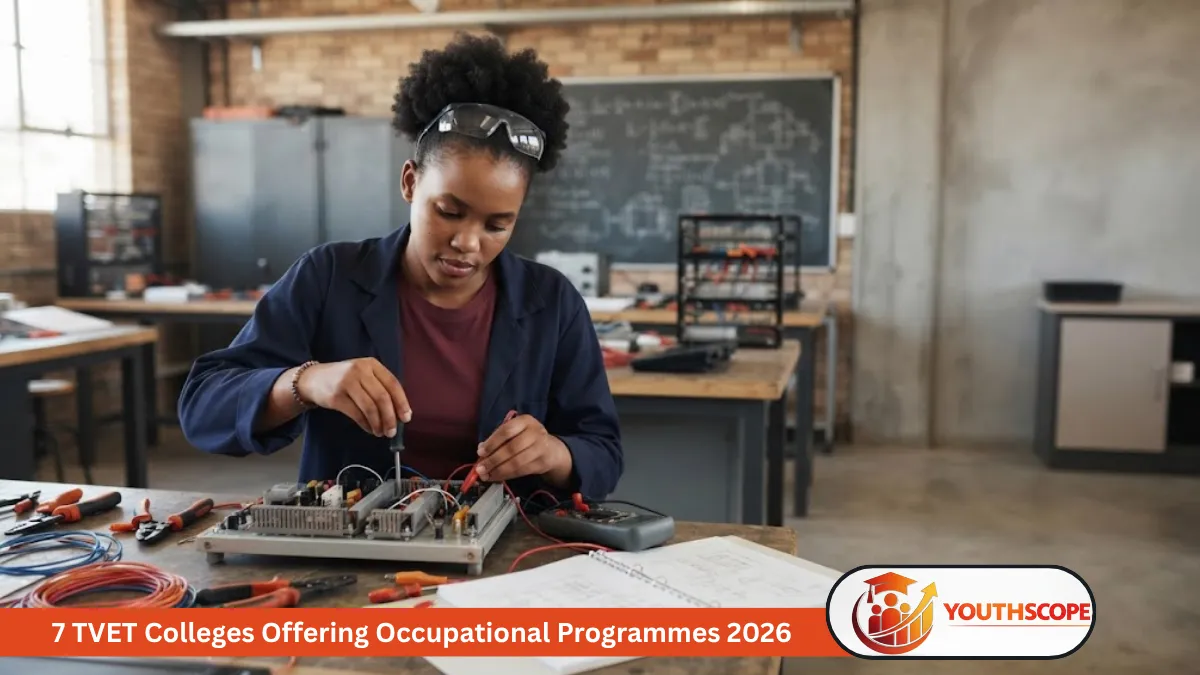
South African students looking for practical, career-focused education can consider occupational programmes at public Technical and Vocational Education and Training (TVET) colleges.
For 2026, the Department of Higher Education and Training (DHET) has published information on occupational qualifications offered at public TVET colleges. These programmes are designed around specific occupations and can combine theoretical learning, practical training and workplace-based learning, depending on the qualification.
Below are seven TVET colleges highlighted for occupational programmes, including opportunities in trades, technology, hospitality, business services and other occupational fields.
7 TVET Colleges Offering Occupational Programmes in 2026
1. ORBIT TVET College
ORBIT TVET College offers occupational programmes focused on practical and occupational skills.
The programmes listed in the supplied 2026 information include:
- Occupational Certificate: Electrician
- Occupational Certificate: Artificial Intelligence Software Developer
- Occupational Certificate: Carpenter and Joiner
- Occupational Certificate: Project Manager
- Occupational Certificate: Diesel Mechanic
- Occupational Certificate: Chef
- Occupational Certificate: Clearing and Forwarding Agent
- Occupational Certificate: Freight Handler
- Occupational Certificate: Boilermaker
- Occupational Certificate: Computer Technician
- Occupational Certificate: Hairdresser
- Occupational Certificate: Beauty and Nail Technology
The college has also been associated with employer partnerships aimed at supporting workplace-based learning.
Applicants should check ORBIT’s latest programme information to confirm which qualifications are available at their preferred campus and intake.
2. False Bay TVET College
False Bay TVET College offers occupational programmes across technical, business and other vocational fields.
The supplied 2026 information lists programmes including:
- Computer Technician
- Bookkeeper
- Management Assistant
- Office Administrator
- Electrician
- Fitter and Turner
- Mechanical Fitter
- Millwright
- Panel Beater
- Welder
- Solar Photovoltaic Service Technician
- Vehicle Painter
False Bay also has a Work Integrated Learning function that works with workplaces and employers to support practical learning opportunities when suitable placements and funding are available.
This means prospective students should distinguish between being enrolled in an occupational qualification and actually having a confirmed workplace placement. A placement should be confirmed through the college’s official process.
3. Northlink TVET College
Northlink TVET College offers a broad range of occupational qualifications and skills programmes.
The supplied 2026 programme information includes occupational fields such as:
- Beauty Therapist
- Cyber Security Analyst
- Early Childhood Practitioner
- Fitness Instructor
- ICT Computer Technician
- Internet of Things Developer
- Panel Beater
- Solar Photovoltaic Service Technician
- Vehicle Painter
- Automotive Motor Mechanic
- Boilermaker
- Bricklayer
- Carpenter
- Diesel Mechanic
- Electrician
- Fitter and Turner
- Mechanical Fitter
- Millwright
- Plumber
Occupational qualifications are designed around particular occupations, so entry requirements and programme structures can differ from one qualification to another.
Applicants should therefore check the requirements for the specific programme they want to study rather than assuming that all Northlink occupational programmes have the same admission criteria.
4. Ekurhuleni West TVET College
Ekurhuleni West TVET College is another public college offering occupational programmes.
The supplied 2026 information identifies programmes including:
- Chef
- Automotive Motor Mechanic
- Computer Technician
- Early Childhood Development Practitioner
- Electrician
- Boilermaker
- Carpenter
- Hairdressing
The college’s occupational training model includes theory, practical training and workplace experience where applicable.
The supplied information also identifies Centres of Specialisation occupational programmes as fully funded programmes, with eligible students receiving NSFAS support subject to the applicable requirements.
Because funding eligibility depends on the programme and student’s circumstances, applicants should confirm funding before registering.
5. South West Gauteng TVET College
South West Gauteng TVET College (SWGC) has introduced occupational programmes as part of its broader occupational training offering.
The college describes occupational programmes as practical and competency-based, with training focused on particular occupations.
Its programme information includes occupational qualifications, Centres of Specialisation, learnerships and short skills programmes.
SWGC has also participated in workplace-based learning initiatives and partnerships involving SETAs and employers.
Students interested in an SWGC programme should check the latest prospectus and campus information before applying because programme availability can change between intakes.
6. Motheo TVET College
Motheo TVET College is included in the national occupational programme expansion.
The supplied information identifies occupational qualifications such as:
- Occupational Certificate: Bricklayer
- Occupational Certificate: Electrician
These programmes are designed around practical occupational competencies rather than purely classroom-based academic study.
Prospective students should check Motheo’s latest programme and campus information before applying to determine whether the qualification they want is available during the relevant intake.
7. Tshwane South TVET College
Tshwane South TVET College is also included among public TVET colleges offering occupational qualifications.
The supplied 2026 information identifies occupational areas including:
- Bricklaying
- Electrical work
The exact programme and campus availability can depend on the intake.
Students should therefore confirm the latest programme list, admission requirements, application dates and campus offering directly with Tshwane South TVET College.
What Are Occupational Programmes?
Occupational programmes are skills-based programmes designed around specific occupations.
According to DHET’s 2026 funding FAQs, occupational programmes at TVET colleges are industry-aligned and can combine theory, practical training and work-based learning where applicable.
In practical terms, a programme can involve three broad learning components.
1. Theoretical learning
Students gain the knowledge needed to understand their chosen occupation.
2. Practical training
Students develop occupational skills through practical training environments such as workshops, laboratories, simulations or other college facilities.
3. Workplace-based learning
Where required by the qualification, learners gain experience in a workplace environment and apply skills acquired during their training.
The exact structure depends on the occupational qualification.
Examples of Occupational Careers
Occupational programmes available across the TVET sector can cover a wide range of career areas.
Examples from the programmes listed above include:
- Electrician
- Boilermaker
- Welder
- Plumber
- Bricklayer
- Carpenter
- Diesel Mechanic
- Automotive Motor Mechanic
- Mechanical Fitter
- Fitter and Turner
- Chef
- Computer Technician
- Cyber Security Analyst
- Solar Photovoltaic Service Technician
- Early Childhood Development Practitioner
- Project Manager
- Beauty Therapist
The availability of each qualification differs between colleges, campuses and intakes.
Can Occupational Programmes Receive NSFAS Funding?
Yes, eligible students enrolled in approved occupational programmes at public TVET colleges may qualify for NSFAS support, subject to the applicable funding rules.
DHET’s 2026 Occupational Programmes Funding FAQs state that eligible students may receive NSFAS support, including tuition and approved allowances.
NSFAS’s 2026 eligibility guidelines also contain specific provisions for occupational qualifications, including rules concerning the intake cycles and the level or type of qualification being studied.
NSFAS states that funding is only available for approved qualifications at eligible public institutions. Students should therefore verify that their specific occupational qualification and college are approved for funding before relying on NSFAS support.
What Does Work-Integrated Learning Mean?
Work-integrated learning, often called WIL, refers to structured learning that connects education with practical workplace experience.
For an occupational student, this can mean applying classroom and practical training in an actual workplace where the qualification requires workplace-based learning.
However, students should not automatically assume that every occupational programme provides an immediate job placement.
Whether workplace learning is required, how it is arranged and when it takes place depends on the qualification and college.
Who Should Consider an Occupational Programme?
Occupational programmes may be relevant to students who want training focused on a particular occupation or trade.
They can be especially relevant to learners interested in areas such as:
- Engineering and technical trades
- Construction
- Automotive work
- Hospitality
- ICT and digital occupations
- Renewable energy
- Beauty and personal care
- Business administration
- Early childhood development
The right choice depends on the learner’s interests, admission requirements, programme availability and intended career pathway.
What Applicants Should Check Before Applying
Programme information can vary by college, campus and intake.
Before submitting an application, prospective students should confirm:
- The exact occupational qualification being offered
- The campus where it is available
- Admission requirements
- Programme duration
- Whether workplace-based learning is required
- Whether applications are currently open
- Application deadlines
- NSFAS or other funding eligibility
- Any programme-specific conditions
Do not assume that because a qualification appears on a national college list it is available at every campus.
How to Apply
There is no single application process that applies identically to all seven colleges.
Applicants should:
- Identify the occupational qualification they want to study.
- Visit the relevant TVET college’s official website.
- Check the latest programme and campus information.
- Read the admission requirements for the specific qualification.
- Confirm whether applications are open.
- Follow the college’s official application process.
- If seeking NSFAS support, check the applicable NSFAS requirements separately.
- Keep proof of the application and monitor the official communication channels for updates.
Students should use official college websites and official NSFAS channels rather than relying solely on social-media posts or third-party advertisements.
Important Date
Application closing date: Not specified in the supplied information.
Because different colleges and programmes can have different application cycles, prospective students should check the relevant college’s current application dates.
Why Occupational Programmes May Be Relevant to TVET Students
Occupational programmes provide a route into education that places emphasis on specific occupational competencies.
Depending on the qualification, students can encounter a combination of classroom theory, practical training and workplace learning. DHET describes these programmes as industry-aligned and skills-based, with the objective of preparing students for specific occupations.
This makes the programme structure different from simply studying a general academic subject.
For students comparing post-school options, the key question is therefore not only which college is closest, but also whether the specific occupation, qualification, campus, funding arrangements and workplace-learning structure match their plans.
Suggested
Suggested future Youthscope:
- TVET colleges offering occupational programmes
- NSFAS funding for TVET students
- TVET courses and qualifications in South Africa
- Skills programmes for South African youth
- How to apply to a TVET college
Frequently Asked Questions
1. What are occupational programmes at TVET colleges?
They are industry-aligned, skills-based programmes designed to prepare students for specific occupations. They can include theoretical learning, practical training and workplace-based learning where applicable.
2. Which TVET colleges are highlighted in this guide?
The seven colleges are ORBIT TVET College, False Bay TVET College, Northlink TVET College, Ekurhuleni West TVET College, South West Gauteng TVET College, Motheo TVET College and Tshwane South TVET College.
3. Can NSFAS fund occupational programmes?
Eligible students may receive NSFAS support for approved occupational qualifications at public TVET colleges, subject to the applicable funding and eligibility rules.
4. Does every occupational programme include workplace learning?
Not necessarily. Workplace-based learning applies where it is required by the particular qualification.
5. Can I study any occupational qualification at any of these colleges?
No. Programme availability varies by college, campus and intake. Students should check the latest programme information from the college before applying.
6. When do applications close?
There is no single closing date for all seven colleges and programmes. The closing date should be confirmed with the relevant college for the specific intake.
Final Reminder
Occupational programmes can provide a practical route into trades, technical occupations, ICT, hospitality, business services and other career fields.
However, programme availability, admission requirements, workplace-learning arrangements and funding can differ between institutions and intakes.
Before applying, check the relevant TVET college’s official information and confirm the latest requirements for your chosen qualification.
Official source
The primary authoritative source for the national occupational-programme and funding information is the Department of Higher Education and Training. DHET currently provides a national resource for the List of TVET Colleges Offering Occupational Programmes and its 2026 funding FAQs explain the occupational-programme model.
For funding requirements, the relevant official source is National Student Financial Aid Scheme (NSFAS), which publishes its 2026 eligibility guidelines and information for TVET students.
Last checked: 21 September 2026.
Author/Updated Information
Written by: Mbalizuke Nkosi
Published: 21 September 2026
Updated: 21 September 2026
Information checked: 21 September 2026

Mbalizuke Nkosi is the editorial voice behind YouthScope.co.za, a South African youth-focused platform dedicated to providing reliable information on opportunities, education, and career development. The platform serves students, graduates, job seekers, and young professionals by delivering accurate, timely, and easy-to-understand content.
Through informative and professionally curated content, YouthScope.co.za aims to equip young people with the knowledge and resources needed to make informed decisions about their education and future careers.
For inquiries or support, please contact admin@youthscope.co.za.